Imagine 100 people walk into a clinic complaining of fatigue.
Some have iron deficiency. Some have sleep apnea. Some have hypothyroidism. Some are severely stressed. Some have long COVID. Some have cancer.
Would we give all 100 people the same treatment?
Of course not.
We would investigate why they are tired.
Yet when it comes to Irritable bowel syndrome (IBS), we often do exactly the opposite.
People with bloating, constipation, diarrhea, abdominal pain, reflux, food sensitivities, and gas are frequently grouped together under a single label and guided through many of the same diets, supplements, medications, and symptom-management strategies, regardless of what’s actually driving their symptoms.
The problem is that IBS is a description of symptoms rather than an explanation of the underlying cause.
In many ways, IBS is a lot like fatigue. It’s something a person experiences, but it doesn’t tell us why they’re experiencing it.
Two people can both have diarrhea and have completely different things driving it. One may have pancreatic enzyme insufficiency. Another may have bile acid malabsorption. Another may have a bacterial overgrowth. Another may have lactose intolerance. Another may have a combination of several factors occurring at the same time.
The same is true for bloating, constipation, reflux, abdominal pain, and many other digestive symptoms.
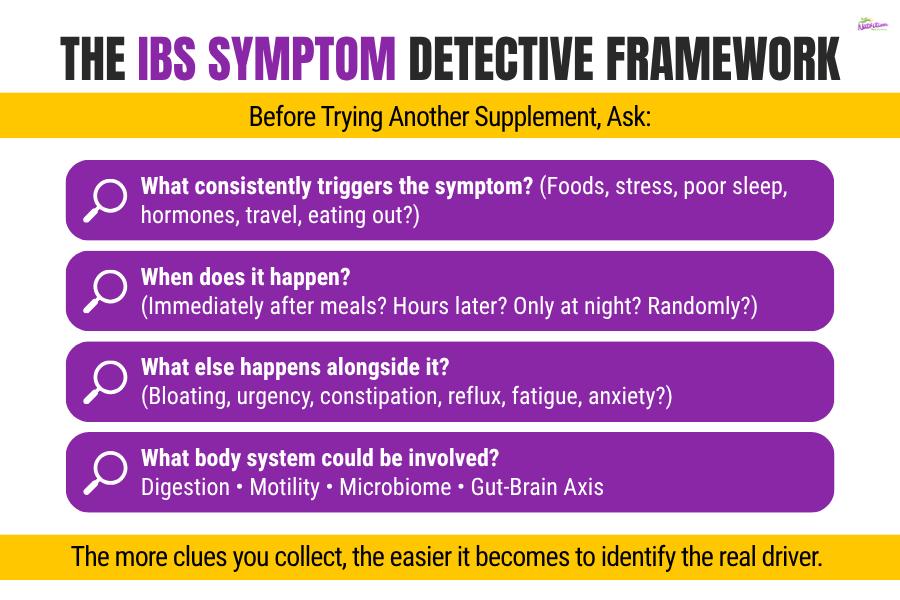
In fact, one of the biggest challenges in gut health is that most people don’t have just one thing contributing to their symptoms. They often have a unique combination of factors involving digestion, motility, the microbiome, the gut-brain axis, food sensitivities, immune activity, nutrient deficiencies, and more.
Every person has a different symptom fingerprint, a different root-cause fingerprint, and ultimately a different roadmap to get better.
This is one of the reasons IBS research has often produced mixed results. Researchers frequently take large groups of people with similar symptoms and give them the same intervention, despite the fact that the underlying reasons for those symptoms may be completely different.
This disconnect between research and clinical practice is one reason many clinicians in the integrative and functional gut health space have been advocating for more personalized approaches. While much of the research has remained relatively linear—testing one intervention across large groups of people with the same diagnosis—many clinicians have been observing something different in practice: outcomes often improve when care is individualized.
A fascinating new study may represent an important step toward the research finally catching up.
Instead of treating people based only on symptoms, researchers individualized treatment based on each person’s microbiome profile.
The results were striking.
More importantly, they reinforce something many functional and integrative gut health clinicians have been observing in practice for years: when treatment becomes more personalized, outcomes often improve.
Why IBS Research Has Always Been So Difficult
The very thing that makes IBS difficult to treat is also what makes IBS difficult to study.
Take probiotics as an example. Some studies show benefit. Some show little effect. Some show mixed results. The same can be said for fiber, low-FODMAP diets, digestive enzymes, peppermint oil, medications, and many other interventions commonly used for IBS.
At first glance, it can make it seem like nothing works particularly well.
But there may be another explanation.
Let’s go back to our fatigue example.
Imagine researchers recruited 100 people struggling with fatigue and gave all of them iron supplements. Some participants would likely improve dramatically. Others might notice no change whatsoever.
At the end of the study, researchers might conclude that iron has a modest effect on fatigue.
But that wouldn’t really be the most accurate conclusion.
The more accurate conclusion would be that iron helps people who are iron-deficient. The problem wasn’t the intervention. The problem was that the study grouped together people with very different reasons for being tired.
IBS research often faces a similar challenge.
Researchers may recruit a large group of people who all meet the criteria for IBS. On paper, they all have similar symptoms, so they get grouped into the same study. But beneath the surface, one person may have pancreatic enzyme insufficiency, another may have SIBO, another may have bile acid malabsorption, another may have lactose intolerance, and another may have significant dysfunction of the gut-brain axis. Some may be dealing with several of these factors at the same time.
Then the study gives everyone the exact same intervention—perhaps a probiotic—and evaluates the results.
What happens?
Some people improve significantly. Some improve a little. Some don’t improve at all.
The final result is often a modest average improvement.
But averages can be misleading.
The probiotic may have been exactly what one subgroup needed while doing very little for another subgroup whose symptoms were being driven by an entirely different mechanism. When you average all of those outcomes together, a potentially powerful intervention can end up looking only modestly effective.
This is one reason so many IBS interventions end up looking only modestly effective in research, even when they may be highly effective for the subset of patients they were actually designed to help.
It’s also one reason many research findings can feel frankly underwhelming from a patient perspective.
You’ll often see studies conclude that an intervention produced a statistically significant improvement in symptoms. And while that’s important from a research standpoint, it doesn’t always translate into the kind of dramatic improvement most patients are hoping for.
In other words, a treatment can produce an improvement that is meaningful to researchers while still leaving many patients wondering, “That’s it?”
Most people aren’t looking for a small reduction in bloating or a slightly better bowel movement. They’re looking to get their lives back. They want to enjoy meals without fear, stop mapping every bathroom in town, travel comfortably, and stop thinking about their gut every waking hour.
In practice, what gets me excited isn’t a small average improvement spread across a large group of people. What gets me excited is seeing someone experience a major improvement in their quality of life because we identified and addressed the factors actually driving their symptoms.
The reality is that an intervention doesn’t need to work for everyone to work extremely well for the right person.
If a probiotic is addressing the reason someone’s symptoms exist in the first place, the results can be very different from what you would expect based on the average outcome of a large IBS study.
The question then becomes: What if, instead of giving the same intervention to everyone with IBS, researchers first identified what was happening beneath the surface and then tailored treatment accordingly?
That is exactly what makes the study we’re about to discuss so interesting.
Looking for a practical place to start?
Download our free 30-Day Low FODMAP Diet Guide, including food lists, recipes, and a grocery list for each week.
The Study That Caught My Attention
This is exactly the question a recent pilot study set out to explore. Researchers looked at a group of patients with post-infectious IBS and, rather than treating participants based solely on symptoms, used microbiome testing to help guide treatment recommendations for one group of patients.
Rather than giving every participant the same intervention, researchers used microbiome testing to identify specific microbial imbalances and then matched treatment recommendations accordingly. Depending on what was found, participants might receive different dietary recommendations, targeted probiotics, prebiotics, supplements, or other interventions designed to address the patterns identified in their microbiome. In other words, the goal wasn’t to find one treatment that worked for everyone. The goal was to find the right treatment for each individual.
In total, 13 patients received microbiome-guided personalized care, while 20 patients received more traditional symptom-based care.
The results were striking.
The microbiome-guided group achieved a 100% response rate, compared to 55% in the symptom-based care group. While this was a small study and certainly not the final word on the topic, the difference was large enough to catch my attention.
Part of what makes this study so interesting is that there simply aren’t many studies designed this way. Most IBS research evaluates whether a specific diet, supplement, medication, or intervention works across a broad group of patients. Far fewer studies ask what happens when treatment is first individualized and then tailored to the unique biology of each person.
While this was a small study and certainly not the final word on the topic, it provides an important glimpse into what the future of IBS care may look like as researchers begin exploring more individualized approaches.
What This Looks Like In Real Life
This study resonated with me so strongly because this is exactly what we do every day at Nutrition Resolution.
Rather than pairing treatments with symptoms, our job is to understand why those symptoms are happening in the first place. We investigate. We look for root causes. We identify the unique combination of factors contributing to each person’s symptoms and then build a plan around what we find.
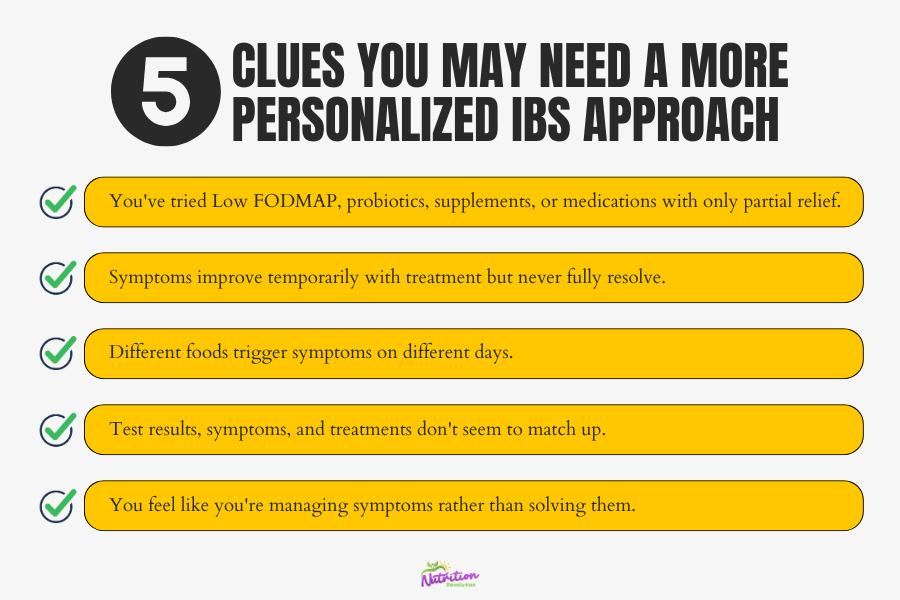
And what I’ve learned after working with thousands of people with digestive issues is that two people can walk through the door with what appears to be the exact same problem, yet the roadmap forward can look completely different.
In fact, sometimes people have nearly identical symptoms and even similar test results, yet what ultimately moves the needle for them ends up being very different.
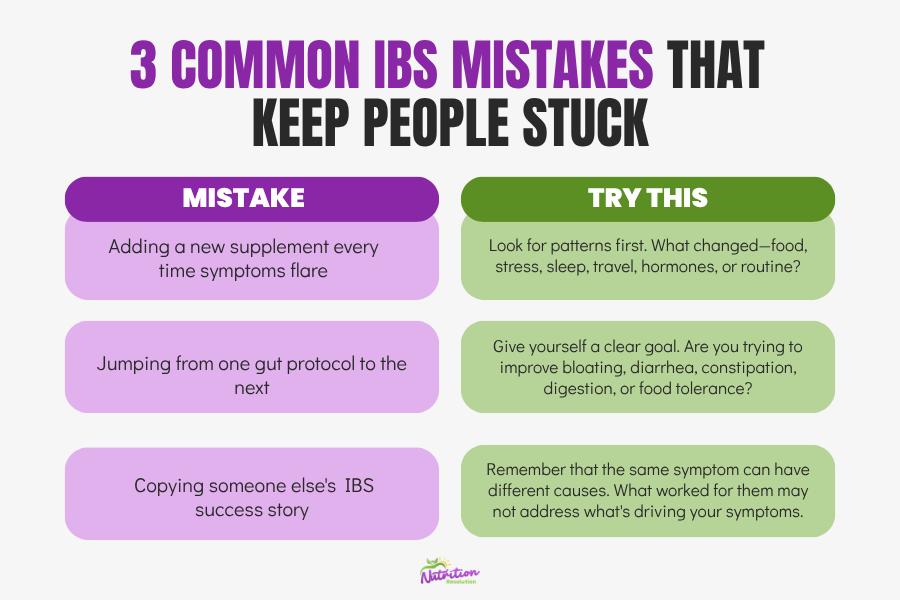
Here are a few examples that immediately came to mind as I was reading this study.
Two Constipation Patients, Two Very Different Outcomes
One of the first examples that came to mind while reading this study was two women I worked with who both struggled with severe constipation.
On paper, they looked remarkably similar.
Both had been constipated for years. Both relied on multiple interventions just to have a bowel movement. Both had already tried increasing fiber, drinking more water, exercising, taking magnesium, and many of the other standard recommendations people are typically given for constipation.
One was taking Linzess, magnesium citrate, and stimulant laxatives and still wasn’t having complete daily bowel movements. The other had a very similar story.
When we tested them, both were positive for methane SIBO.
If you were taking a one-size-fits-all approach, you might assume the solution was straightforward: address the methane and the constipation should improve.
For the first patient, that’s exactly what happened.
As we addressed the methane overgrowth and worked through the factors contributing to it, her constipation improved dramatically. Over time, she went from relying on multiple medications and supplements just to get through the week to having regular bowel movements with far less support.
The second patient was different.
As her methane levels improved, some symptoms got better, but the constipation remained stubbornly persistent. That was an important clue that something else was contributing to the picture.
As her methane improved, we expected her constipation to improve right along with it. When it didn’t, that was a clue that something else was going on. We referred her to one of our trusted pelvic floor physical therapy partners, where she was ultimately found to have significant pelvic floor dysfunction that was preventing normal evacuation. Once that piece was addressed, things finally began to move in the right direction—no pun intended.
From the outside, both patients appeared to have the same problem.
Both had constipation.
Both had methane SIBO.
Both had tried many of the same interventions.
Yet the roadmap forward ended up being different because the factors driving their symptoms were different.
This is exactly why individualized care matters.
Two Diarrhea Patients, Two Very Different Drivers
Another example that came to mind was two women who both came to us struggling with chronic diarrhea.
On the surface, their stories sounded remarkably similar. Both dealt with urgency, loose stools, bloating, and significant anxiety around being away from a bathroom. Both had already experimented with various elimination diets and supplements. Both had been told they had IBS-D.
In both cases, testing suggested bacterial overgrowth was part of the picture.
But as we dug deeper, it became clear that the primary drivers of their symptoms were very different.
For the first patient, one of the biggest clues was that her symptoms consistently worsened after higher-fat meals. As we dug deeper using functional testing, we found evidence of significant bile acid malabsorption. This is something we sometimes see alongside bacterial overgrowth, as certain bacteria can interfere with normal bile acid metabolism and reabsorption.
However, it doesn’t happen in everyone, and in her case, it became clear that addressing the bacterial overgrowth alone wasn’t enough. While the overgrowth was likely contributing to the picture, it also became important to support bile acid handling as part of her overall plan.
As we addressed both the bacterial overgrowth and the bile acid issues contributing to her symptoms, her urgency became far more manageable, her stools became more predictable, and she regained the confidence to leave the house without constantly worrying about where the nearest bathroom was.
The second patient looked similar on paper but responded very differently. Like the first patient, testing suggested bacterial overgrowth was contributing to the picture. We addressed the overgrowth, made dietary changes, and saw some improvement, but she continued experiencing frequent loose stools, bloating, and difficulty maintaining weight.
That was an important clue that something else was going on.
As we dug deeper, additional testing revealed significant pancreatic enzyme insufficiency. This is something that can sometimes be overlooked because many conventional evaluations are primarily focused on identifying severe pancreatic insufficiency, while milder—but still clinically meaningful—digestive insufficiency may continue contributing to symptoms.
While the bacterial overgrowth was certainly part of the picture, it became clear that impaired digestion and absorption were also playing a significant role in her ongoing symptoms.
Once we added appropriate digestive support and improved her ability to properly break down and absorb food, her stools became more formed, her bloating improved, and she was finally able to maintain her weight more consistently.
From the outside, both patients appeared to have the same problem.
Both had chronic diarrhea.
Both had bloating.
Both had bacterial overgrowth contributing to the picture.
Yet the most important next step for each patient ended up being completely different.
This is why we spend so much time trying to understand what is actually driving symptoms rather than simply matching treatments to diagnoses.
Two Patients With Bloating, Two Very Different Roadmaps
Bloating is another great example.
I immediately think of two patients who both came to us describing severe bloating after meals. Both looked several months pregnant by the end of the day. Both had become increasingly afraid of food because they felt like almost everything they ate caused symptoms. Both had already experimented with elimination diets and had long lists of foods they believed they couldn’t tolerate.
At first glance, their stories sounded remarkably similar.
For the first patient, the biggest clue was that her symptoms could be traced back to a severe bout of food poisoning. Prior to that event, she had never struggled with digestive symptoms to this degree. Further testing and evaluation suggested a classic post-infectious IBS picture. The food poisoning appeared to have triggered lasting changes in gut function and motility, and bacterial overgrowth was also contributing to many of her symptoms.
As a result, much of our focus was on supporting motility, addressing the bacterial overgrowth, and using dietary strategies often incorporated into SIBO care. This included dietary modifications aimed at reducing fermentation, antimicrobial interventions, and gradually expanding the diet to rebuild food tolerance as her symptoms improved.
The second patient initially appeared very similar. She also experienced significant bloating after meals and had become increasingly restricted with food. But as we dug deeper, we noticed a very different pattern. Her symptoms weren’t limited to digestion. She experienced flushing, headaches, skin reactions, and periods where foods that seemed completely safe one week suddenly caused problems the next. Those clues pointed us toward a histamine and mast cell picture.
Rather than focusing primarily on fermentation and motility, much of our work centered around calming histamine reactivity. We used a low-histamine diet, DAO enzyme support, nutritional strategies aimed at improving histamine tolerance, and other interventions designed to calm the immune activation contributing to her symptoms.
Even though both patients complained primarily of bloating, the interventions ended up looking remarkably different because the mechanisms driving their symptoms were different.
From the outside, both patients appeared to have the same problem. Both experienced severe bloating. Both had become fearful of food. Both had dramatically restricted their diets. Yet the factors driving those symptoms were completely different, which meant the path toward improvement was different as well.
Wondering if bacterial overgrowth may be contributing to your symptoms?
Many people with IBS struggle with bloating, gas, food sensitivities, diarrhea, constipation, or a combination of symptoms that may be influenced by excessive fermentation in the gut.
Download our free 7-Day SIBO Meal Plan, complete with recipes, grocery lists, and practical meal ideas designed to help reduce fermentation and calm digestive symptoms.
Why This Matters Beyond One Study
What makes this study exciting isn’t just the outcome itself.
It’s what the study represents.
For years, personalized medicine has been gaining traction across many areas of healthcare. We don’t assume every person with fatigue needs the same treatment. We don’t assume every person with infertility needs the same protocol. We don’t assume every person with diabetes should receive the exact same intervention.
We investigate.
We test.
We individualize.
Yet when it comes to IBS and other digestive disorders, research has historically been slower to move in that direction. Much of the focus has been on identifying a single diet, supplement, medication, or intervention that works across large groups of people.
The challenge, as we’ve discussed throughout this article, is that people with the same symptoms often arrive there through very different pathways.
One criticism that has long surrounded stool testing and microbiome testing is: What are you actually supposed to do with the information?
That’s a fair question.
Data by itself doesn’t help anyone.
A test only becomes useful if the information changes what you do.
One thing I found especially interesting about this study is that it mirrors how we think about testing in our practice. We do incorporate microbiome testing in appropriate cases at Nutrition Resolution, but never as a standalone answer or because we think one stool test can explain everything. Instead, we use it as one piece of a larger clinical picture alongside symptoms, history, digestion, motility, food patterns, and other testing when needed.
The goal is never to collect more data for the sake of data. The goal is to gather information that helps us make more personalized decisions and create a roadmap that actually fits the person in front of us.
What makes this study so interesting is that the researchers actually acted on the microbiome information they collected. They didn’t simply gather data and stop there. They used the findings to individualize care. Different findings led to different recommendations. Different recommendations led to different outcomes.
And that’s really the bigger takeaway.
The future of IBS care may not be about finding one intervention that works for everyone.
It may be about getting better at identifying the unique factors contributing to each person’s symptoms and building a plan around what we find.
The Missing Piece: Sequence Matters
There’s one more layer to this conversation that I think often gets overlooked.
It’s not just what you do.
It’s what you do first.
In other words, identifying the right interventions is only part of the equation. The other question is whether those interventions are being introduced at the right time and in the right order.
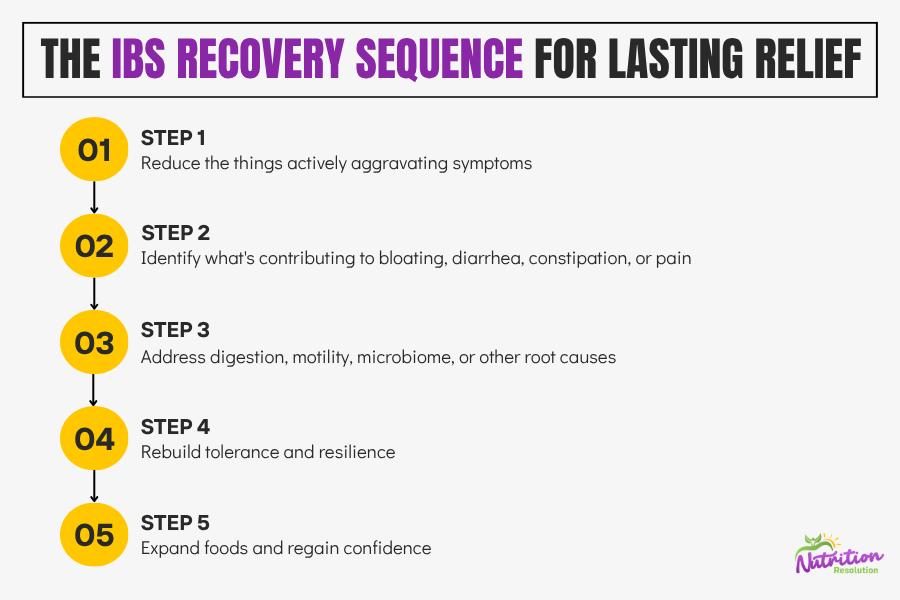
This is something we think about constantly at Nutrition Resolution because another pattern we see all the time is people trying many of the right things, but in the wrong sequence.
Take glutamine as an example.
Glutamine is often marketed as a way to “heal the gut,” and for the right person at the right time, it can absolutely be a helpful tool. But if someone has active bacterial overgrowth, impaired digestion, significant fermentation, and severe symptoms, simply adding glutamine is unlikely to solve the problem.
Before the gut can effectively repair, we first have to remove or reduce what’s irritating it in the first place.
In many cases, that means supporting digestion, reducing excessive fermentation, calming symptoms, and addressing bacterial overgrowth before shifting our focus toward rebuilding and repair.
Trying to heal the gut while the factors driving the irritation are still active is a little bit like trying to put out a fire while continuing to pour fuel onto it. The repair support isn’t necessarily wrong. It’s just being introduced before the underlying problem has been adequately addressed.
And that’s really the bigger point: sequence matters.
You wouldn’t repaint a house while the roof was still leaking. You wouldn’t plant a garden before pulling the weeds. You wouldn’t try to rebuild strength on a sprained ankle before allowing the injury to calm down. The same concept applies to digestive health.
Sometimes adding probiotics before addressing an active overgrowth can backfire. Sometimes, adding large amounts of fiber before addressing methane SIBO can make symptoms worse. Sometimes aggressively expanding foods before calming significant histamine or mast cell activation can leave someone feeling discouraged and defeated.
The challenge isn’t simply identifying the pieces of the puzzle. It’s understanding how those pieces fit together.
First, we work to calm and prime the system. Then we identify the factors contributing to symptoms. From there, we address issues involving the microbiome, digestion, motility, and other root causes. As symptoms stabilize, we focus on rebuilding resilience, expanding food variety, and helping people regain confidence in their bodies.
Because in many cases, the difference between getting stuck and making progress isn’t what you’re doing. It’s the order in which you’re doing it.
How We Approach IBS Differently at Nutrition Resolution
If there is one major takeaway from this study, and from the real-world examples we see in practice, it is this: the future of IBS care is likely to become increasingly personalized.
In many ways, that shift is already underway.
For years, many clinicians in the integrative and functional gut health space have been approaching IBS through a more individualized lens—looking beyond symptom labels, investigating underlying contributors, and tailoring recommendations to the unique physiology of each person.
What makes this study exciting is that it may represent an important step toward the research beginning to catch up with that approach.
That is exactly why we approach gut health the way we do at Nutrition Resolution.
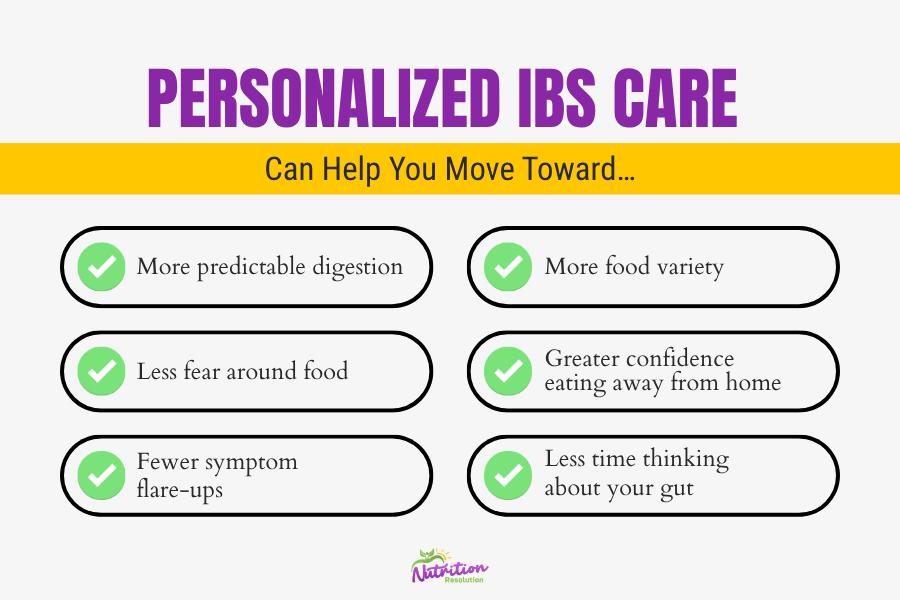
We do not simply match symptoms to supplements, hand everyone the same diet, or assume that one protocol will work for every person with bloating, constipation, diarrhea, reflux, or food reactions. We investigate what is actually contributing to your symptoms, use testing when appropriate, and build a plan around your specific findings.
But we also do not just throw everything at the wall at once.
Your plan needs to be personalized, but it also needs to be sequenced in a way that makes sense. We help identify the unique combination of factors contributing to your symptom picture, then walk you step by step through what to address first, what to address next, and how to rebuild from there.
Because lasting improvement usually does not come from finding one perfect supplement or one perfect diet.
It comes from understanding what is happening in your body and having a clear roadmap for how to move forward.
If you are struggling with ongoing IBS symptoms and feel like you have been handed generic advice that does not fully explain what is going on, we would love to help you think through a more personalized path forward.
You can start by scheduling a 15-minute strategy call, where we will talk through what is going on, decide if working together makes sense, and outline what a plan of working together could look like.