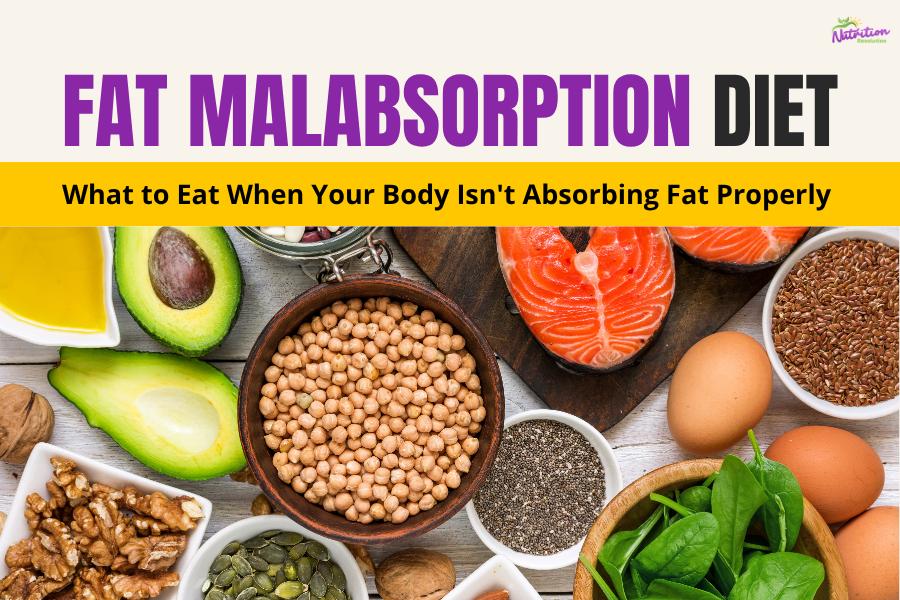
If you are dealing with urgent, watery diarrhea after meals, you may feel as though almost anything you eat can set it off. You may have already eliminated dairy, gluten, high-FODMAP foods, and anything else that seemed suspicious, only to find that the diarrhea continued while your list of “safe” foods kept getting shorter.
When someone tells me they are following a strict low FODMAP diet and still having frequent, urgent chronic diarrhea with very little improvement, that gets my attention. It makes me question whether FODMAPs are really the primary problem and consider whether bile acid diarrhea could be part of the picture.
With bile acid diarrhea, the problem is not necessarily a specific food. It may be the amount of dietary fat in a meal and how your body is handling the bile acids released to digest it. When excess bile acids reach the colon, they can pull in water and cause loose stools, urgency, and that familiar need to know exactly where the nearest bathroom is.
Fortunately, this does not mean you need to eliminate fat or live on bland food forever. Once you understand the pattern, the approach to a diet for bile acid diarrhea is usually much more manageable. We are looking at how much fat your digestive system can handle at one time, how to distribute it throughout the day, and how tools such as soluble fiber may help. You are learning to manage your diet, not become a prisoner to it.
In this article, I will walk you through what that looks like in real life, including which foods tend to work well, which meals are more likely to cause symptoms, and how to make practical adjustments based on your own tolerance.
Want the complete food list and meal plan?
Download our free Bile Acid Diarrhea Diet Guide, a practical bile acid malabsorption diet sheet that includes a more complete list of foods to include and limit, practical meal ideas, a seven-day meal plan, and a grocery list.
What Is Bile Acid Diarrhea?
Bile acid diarrhea happens when more bile acids than usual reach the colon. Once they get there, they stimulate the colon to release water and move its contents through more quickly. That can lead to frequent, watery diarrhea, often with very little warning.
To understand why, it helps to know what bile acids are supposed to do in the first place.
Your liver makes bile, and your gallbladder stores and concentrates it between meals. When you eat, especially when you eat fat, bile is released into the small intestine. The bile acids help break that fat down so your body can absorb it, along with the fat-soluble vitamins A, D, E, and K.
So bile acids are not bad. You need them. The problem is simply that you need them in the right place.
Once bile acids have done their job in the small intestine, your body is designed to recycle them. About 95% are normally reabsorbed, primarily in the last part of the small intestine, and carried back to the liver to be used again.
But if too many bile acids escape that recycling process and spill into the colon, the colon does not particularly appreciate it. The bile acids stimulate the release of water and electrolytes, irritate the colon, and trigger stronger contractions that push stool through faster. Now you have more fluid entering the colon and less time to reabsorb it. That combination helps explain why the diarrhea can be so watery, so urgent, and so difficult to control.
You may also hear this called bile malabsorption, or, more commonly, bile acid malabsorption (BAM). The terms are often used interchangeably, but they don’t mean exactly the same thing.
Bile acid malabsorption describes what happens when the small intestine does not reabsorb bile acids properly. That can occur when the terminal ileum has been damaged by inflammatory bowel disease, particularly Crohn’s disease, radiation treatment, or surgery involving that part of the intestine.
But in some people, the problem is not poor absorption. Instead, the liver keeps making too many bile acids because the normal signal telling it to slow down is not working properly. When this happens without another identifiable condition causing it, it is often referred to as idiopathic bile acid diarrhea. In that situation, “malabsorption” does not fully describe the problem. Bile acid diarrhea, or BAD, is the broader and often more accurate term because it includes both possibilities.
In countries where it is available, the SeHCAT scan is considered the gold-standard test for diagnosing bile acid malabsorption because it measures how well your body retains bile acids over several days. Unfortunately, the SeHCAT scan is not available in the United States, so American clinicians often rely on a person’s symptoms, medical history, response to treatment, and other available tests when bile acid diarrhea is suspected.
What Does Bile Acid Diarrhea Look Like?
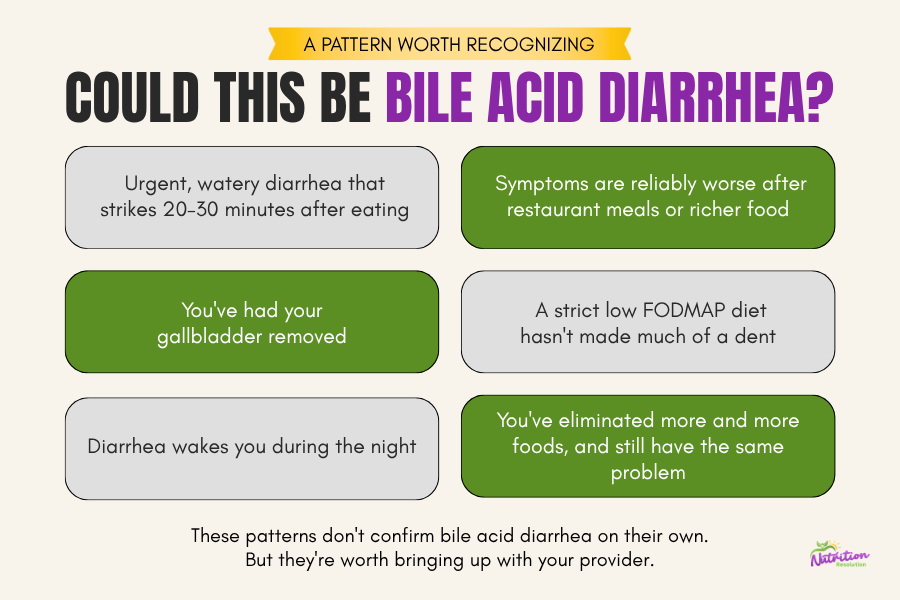
The symptoms can look a little different from one person to another, but I commonly listen for:
- Watery or very loose stools, often corresponding to Bristol Stool Chart types 6 or 7, which may sometimes appear yellow
- Diarrhea that comes on soon after eating
- A sudden, intense need to find a bathroom
- Frequent bowel movements
- Abdominal cramping
- Waking during the night to have diarrhea
- Difficulty holding a bowel movement or occasional accidents
Those are all important pieces of the puzzle when diagnosing bile acid diarrhea, although symptoms alone cannot confirm it.
And then there is the part that does not always make it onto a symptom list: the way this begins to run your life.
Keri’s diarrhea started not long after she had her gallbladder removed. At the time, no one connected the two. She was eventually told she had IBS-D, so she did what many people do when they are desperate to figure out which food is causing the problem: she started taking foods away.
First it was dairy. Then gluten. Then onions and garlic. Eventually, she was following a very limited low-FODMAP diet, but she was still having urgent, watery diarrhea.
Keri learned that she could usually get through a morning appointment if she skipped breakfast. Before a road trip, she simply would not eat. If friends invited her to lunch, she would look at the menu, check how far the restaurant was from home, and start thinking about where the bathrooms would be before she even decided whether to go.
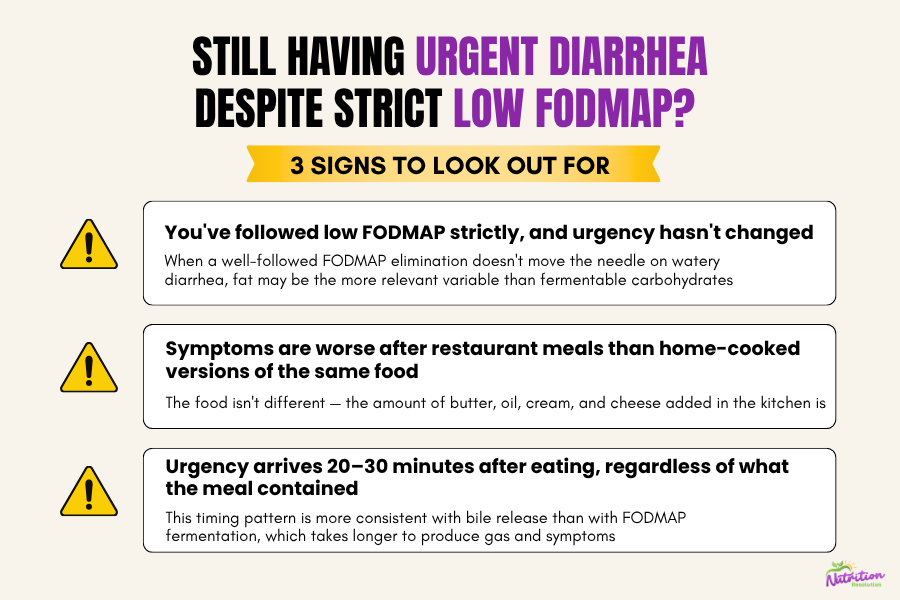
Restaurant meals were the biggest gamble. She might feel completely fine while eating and then, 20 or 30 minutes later, need to find a bathroom immediately.
This is the kind of pattern I pay very close attention to in my work with clients. Keri’s history did not automatically prove that she had bile acid diarrhea. But urgent, watery diarrhea that began after gallbladder removal and was especially likely after richer meals was an important clue. It deserved more investigation than simply assuming she had another food intolerance.
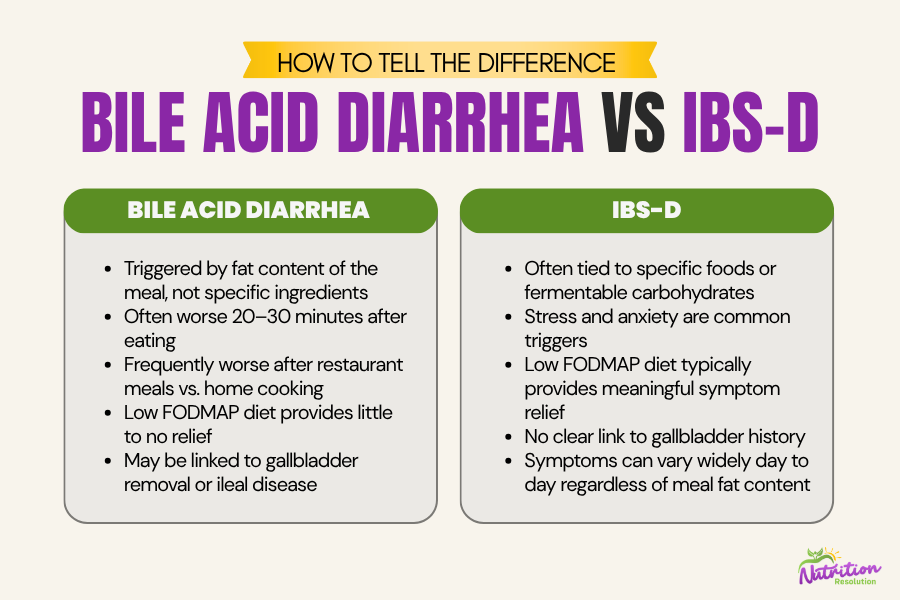
Bile acid diarrhea is frequently mistaken for diarrhea-predominant irritable bowel syndrome, or IBS-D, because the symptoms overlap so much. In fact, research suggests that bile acid malabsorption may be present in more than one-quarter of patients who meet the diagnostic criteria for IBS-D.
That does not mean that everyone with IBS-D actually has bile acid diarrhea. Other conditions, including microscopic colitis, can also cause chronic watery diarrhea and should be considered when someone has persistent symptoms. And it does not mean that everyone who has their gallbladder removed will develop bile acid diarrhea, either. But gallbladder removal is a recognized risk factor, and persistent watery, urgent diarrhea should not automatically be blamed on dairy, gluten, FODMAPs, or whatever food happened to be on the plate that day.
Sometimes the most important clue is not one particular food. It is the timing, the type of meal, the person’s medical history, and the pattern that emerges when we finally put all of those pieces together.
Why Does Fat Make Bile Acid Diarrhea Worse, and How Much Should You Eat?
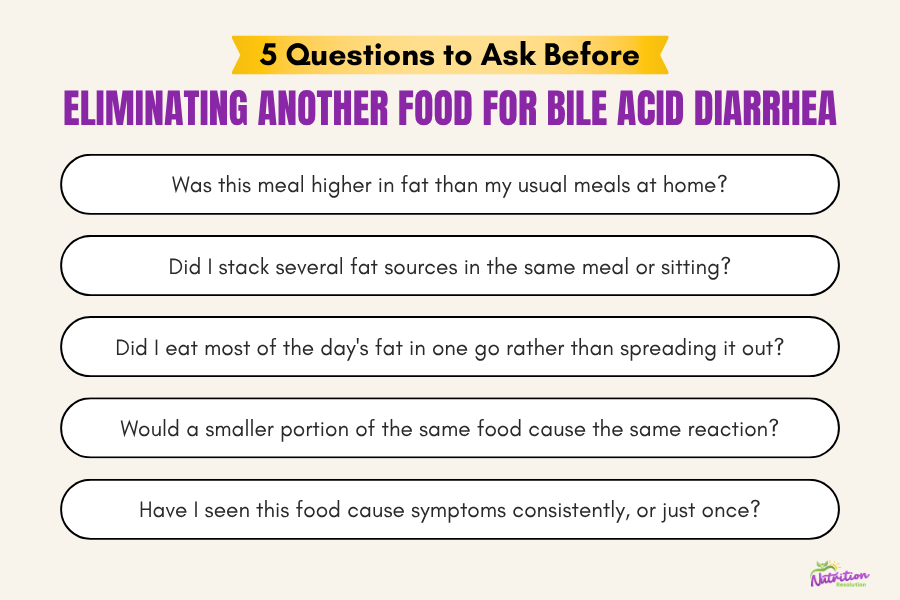
Fat can make bile acid diarrhea worse because eating fat signals your digestive system to release bile. If your body is not reabsorbing bile acids efficiently, or if it is producing more than it can recycle, a higher-fat meal can mean more bile acids reaching the colon. But there is no single amount of fat that works for everyone. The goal is to find the amount you can comfortably tolerate, not to remove fat from your diet altogether.
This is where the relationship between food and symptoms can become confusing. You may eat a meal containing chicken, potatoes, and vegetables one day and feel fine, then eat what looks like a similar meal at a restaurant and have urgent diarrhea before you even make it home.
The difference may not be the chicken or the potatoes. It may be the butter used on the vegetables, the oil added during cooking, the creamy sauce, or the dressing you barely noticed. Restaurant meals can contain much more fat than the same foods prepared at home, even when nothing on the plate looks particularly greasy.
I mean, think about restaurant mashed potatoes. They taste much richer than the version you would make at home because the restaurant is probably using far more butter or cream than you ever would. The same goes for vegetables that arrive glistening with oil or a piece of fish that has been finished with butter. The meal may look simple, but that does not necessarily mean it is low in fat.
And the type of fat is not always the issue. Olive oil, avocado, nuts, seeds, and salmon are nutritious foods. They are often called “healthy fats,” and metabolically, they generally are. Unsaturated fats can support heart health and healthier cholesterol levels, and foods like salmon also provide beneficial omega-3 fatty acids. But your digestive tract still has to process them as fat. They still stimulate bile release, and a large amount at one meal can still worsen bile acid diarrhea.
I see people get tripped up by this all the time. They assume that if olive oil is healthy, more must be better. So they cook their eggs in oil, add half an avocado, sprinkle on cheese, and perhaps have nuts on the side. None of those foods is inherently a problem, but together they can create a fairly high-fat meal.
With bile acid diarrhea, the amount of fat in the entire meal may matter more than whether any one food is “good” or “bad.”
So, How Much Fat Should You Aim For?
You will sometimes see recommendations to follow a low fat diet by keeping fat below 40 grams per day or around 20% of total calories. That guidance comes from one prospective study of a diet providing approximately 20% of calories from fat. Participants with confirmed bile acid malabsorption experienced improvements in urgency, bowel frequency, bloating, and bowel control, and their average intake after the intervention was about 42 grams of fat per day.
That data gives us a helpful clinical reference point, but it does not mean that everyone with bile acid diarrhea needs exactly 40 or 42 grams of fat. The research on diet for bile acid diarrhea is still limited, and your needs depend on your calorie requirements, symptom severity, medical history, nutritional status, and whether you are also taking bile acid sequestrants.
In our practice, I’m often more interested in the pattern than in immediately handing someone a strict daily number.
Is most of the day’s fat concentrated in one meal? Do symptoms happen after restaurant meals but not after similar meals at home? Does breakfast go well until several sources of fat are combined? Can the person tolerate a small amount of avocado but not avocado, eggs, cheese, and cooking oil all in the same sitting?
Those details help us figure out whether the better first step is lowering total fat, spreading it more evenly across the day, or simply reducing the largest portions.
For example, someone may tolerate a modest amount of peanut butter on toast in the morning and olive oil with dinner. But if they have peanut butter, full-fat yogurt, nuts, avocado, and a generous pour of olive oil within the same meal, that total amount may overwhelm their current tolerance.
This is also why I don’t love giving people a list of foods that are either “allowed” or “not allowed.” A food may work perfectly well in one portion and cause symptoms in another. It may also be tolerated as part of a simple meal but not when it is stacked with several other sources of fat.
You need some fat to absorb vitamins A, D, E, and K, obtain essential fatty acids, meet your calorie needs, and make meals satisfying. An unnecessarily severe low-fat diet can lead to weight loss, inadequate nutrition, and an increasingly limited relationship with food.
So, no, the goal is not to eat as little fat as humanly possible. It is to reduce the amount enough to calm symptoms, pay attention to how much you are eating at one time, and then adjust based on what your body is actually telling you.
If you’re wondering what a moderate-fat approach actually looks like on the plate, our Bile Acid Diarrhea Diet Guide includes detailed food lists, practical portion and preparation tips, and a complete seven-day meal plan with a grocery list. It is designed to help you put these principles into practice without having to calculate the fat in every bite or live on an impossibly restrictive diet.
What Foods Can You Eat With Bile Acid Diarrhea?
Most people with bile acid diarrhea can eat a wide variety of foods. A BAM diet, or diet for bile acid malabsorption, tends to be better tolerated when meals are built around lean protein, grains or other starches, fruits and vegetables, and moderate portions of fat. The goal is not to find a tiny list of completely “safe” foods. It is to create satisfying meals that give your digestive system a more manageable amount of fat at one time.
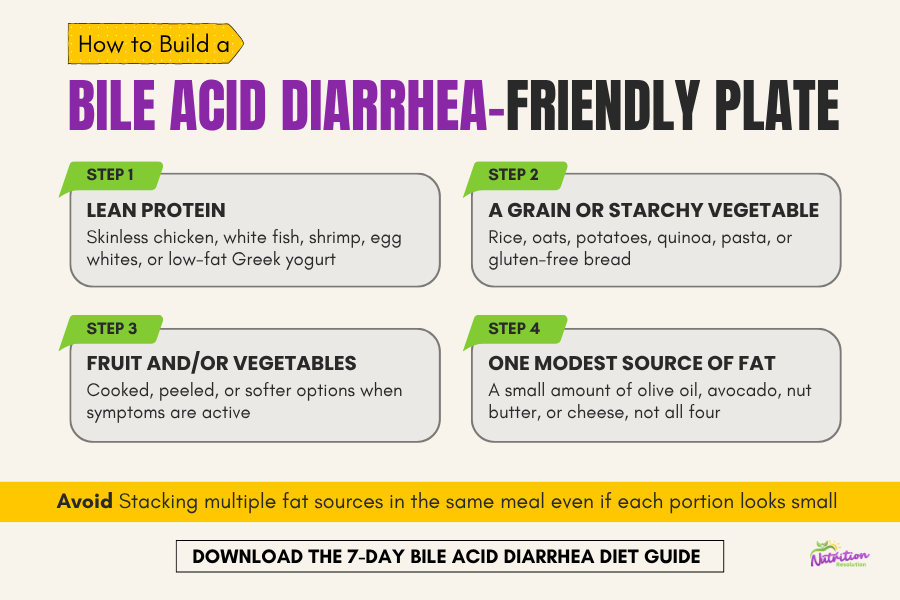
A simple place to start is by building meals from four basic parts:
- A lean source of protein
- A grain or starchy vegetable
- Fruit, vegetables, or both
- A modest amount of fat for flavor, nutrition, and satisfaction
That could look like grilled chicken with rice, cooked zucchini, and a small amount of olive oil. Or oatmeal with banana and low-fat Greek yogurt. Or baked fish with potatoes and green beans.
Nothing about those meals is especially unusual. That is the point. Eating for bile acid diarrhea does not require specialty products or a complicated list of foods no one else in your household would want to eat.
Which Proteins Are Usually Easier to Tolerate?
Lean proteins make it easier to get enough protein without using up most of your fat tolerance in one part of the meal. Options may include:
- Skinless chicken or turkey
- Fish and seafood
- Lean cuts of beef or pork
- Egg whites, or a combination of whole eggs and egg whites
- Beans, lentils, tofu, or tempeh, if you tolerate them
- Low-fat Greek yogurt, cottage cheese, or other reduced-fat dairy products
This does not mean you can never eat salmon, whole eggs, or a higher-fat cut of meat again. It simply means that leaner proteins may be easier to work with while symptoms are active because they leave more room for fat elsewhere in the meal.
For example, if you choose salmon, which naturally contains more fat, you may want to prepare the vegetables with less oil. If you choose chicken breast, you may have more flexibility to add avocado or dressing. We are looking at the whole plate, not judging each food in isolation.
Which Carbohydrates Can You Include?
Rice, potatoes, oats, quinoa, pasta, bread, and other grains can all fit into a bile acid diarrhea diet. These foods provide energy and can help make a moderate-fat meal feel substantial and satisfying.
This is important because people often lower fat and accidentally lower calories at the same time. They remove cheese, oil, nuts, avocado, creamy sauces, and richer meats, but they do not replace that energy with anything else. Then they are hungry, losing weight, or trying to get through the day on grilled chicken and vegetables.
A moderate-fat diet still needs to be enough food.
Carbohydrate foods are not merely fillers, either. Oats, barley, beans, lentils, and certain fruits and vegetables also provide soluble fiber, which may help improve stool consistency. We will talk more about how to use soluble fiber later, because increasing it too quickly can create an entirely different set of problems.
Can You Eat Fruits and Vegetables?
Yes, fruits and vegetables are still an important part of the diet. But when diarrhea is especially active, cooked, peeled, canned, or softer options may be easier to tolerate than a very large raw salad or a plate full of coarse, fibrous vegetables.
You might start with foods such as:
- Bananas, applesauce, melon, peaches, or canned fruit packed in juice
- Cooked carrots, zucchini, squash, green beans, or peeled potatoes
- Soups containing soft vegetables, rice, noodles, or lean protein
- Oatmeal, baked fruit, or smoothies made without a large amount of added fat
This does not mean raw produce is bad for bile acid diarrhea or needs to be removed permanently.
I often explain this as changing the form of the food before eliminating the food itself. An apple may not sit well, but applesauce might. A large raw broccoli salad may worsen symptoms, while a smaller portion of well-cooked broccoli may be perfectly manageable. Those distinctions can preserve far more variety than automatically placing the entire food on a “never eat” list.
What Should You Eat When Diarrhea Is Especially Active?
When symptoms are flaring, temporarily simplify your meals and choose foods that are lower in fat, softer in texture, and familiar to your digestive system. Rice, oatmeal, toast, potatoes, bananas, applesauce, soup, lean poultry, fish, and cooked vegetables can provide a useful foundation.
But “simple” does not need to mean skipping meals or surviving on crackers.
Try something like oatmeal with banana for breakfast, a turkey sandwich with applesauce at lunch, and baked chicken with rice and cooked carrots for dinner. Once symptoms begin to settle, you can gradually bring back more variety, texture, and moderate portions of fat.
This was an important shift for Keri. She had spent years removing dairy, gluten, onions, garlic, and other foods because she assumed one of them must be causing the diarrhea. Once we started paying attention to the fat in the entire meal, she realized that many of those foods were not the problem at all.
She could tolerate toast. She could tolerate potatoes. She could even tolerate some dairy. What she struggled with was a rich restaurant meal containing butter, oil, cheese, and a creamy sauce all at once.
That gave us a much more useful direction. Instead of continuing to shrink her diet, we could begin rebuilding meals around foods she already tolerated and adjust the amount and distribution of fat.
Want Help Putting This Into Practice?
Our Bile Acid Diarrhea Diet Guide includes detailed food lists, portion and preparation guidance, practical tips, and a complete seven-day meal plan with a grocery list. It is designed to show you what this approach can look like in real life, without requiring you to calculate the fat in every bite or live on an unnecessarily restrictive diet.
What Foods Should You Limit With Bile Acid Diarrhea?
Foods that are especially high in fat are the most likely to be limited on a bile acid malabsorption diet, particularly when several sources of fat are combined in one meal. That often includes fried foods, fatty meats, full-fat dairy products, rich sauces, pastries, and meals prepared with generous amounts of butter or oil. But “limit” does not necessarily mean “never eat again.” The amount you eat, what else is on the plate, and how active your symptoms are all matter.
The most common higher-fat foods to watch include:
- Fried chicken, French fries, onion rings, and other deep-fried foods
- Bacon, sausage, hot dogs, and higher-fat cuts of beef or pork
- Pizza, burgers, and creamy pasta dishes
- Butter, heavy cream, sour cream, and full-fat cheese
- Creamy soups, gravies, Alfredo sauce, and rich salad dressings
- Donuts, croissants, pastries, cookies, and other baked goods made with a significant amount of butter or shortening
- Large portions of nuts, nut butter, avocado, coconut milk, or added oils
- Fast food and restaurant meals with multiple sources of fat
Some of these are obvious. You probably already know that a basket of fried food is high in fat. Others are much easier to underestimate.
These are the kinds of foods people are often told to avoid on a lower-fat diet, but portion size and the way foods are combined matter just as much.
A salad, for example, may sound like the safest thing on the menu. But add cheese, avocado, nuts, bacon, a creamy dressing, and chicken cooked in oil, and it may contain as much fat as the burger you were trying not to order.
I see this happen with smoothies, too. Someone starts with fruit, then adds full-fat yogurt, peanut butter, chia seeds, coconut milk, and perhaps half an avocado. Every ingredient has a nutritional benefit, but together they create a very high-fat drink that can move through the digestive system quickly.
Again, the issue is not that any one of those foods is bad. It is the cumulative amount.
What Is “Fat Stacking”?
Fat stacking is what happens when several moderate or high-fat foods are combined in the same meal. Each individual portion may seem reasonable, but the total can exceed what your digestive system currently tolerates.
Think about a breakfast made with two whole eggs cooked in oil, cheese, avocado, and bacon. You may assume bacon is the problem. But removing the bacon while keeping all the other sources of fat may not reduce the meal enough to make a meaningful difference.
A better approach might be to choose one or two sources of fat instead of four. You could have one whole egg with additional egg whites, use less oil in the pan, and choose either cheese or avocado. The meal still feels like breakfast. We have simply made the total fat load more manageable.
This is often far more useful dietary advice than placing eggs, cheese, avocado, and bacon on four separate lists of foods you believe you cannot eat.
Do You Need to Avoid All Restaurant Food?
No, but restaurant meals can be harder to predict because you do not control how much butter, oil, cream, or dressing is used. Foods described as grilled, roasted, or sautéed may still be prepared with considerably more fat than you would use at home.
You do not need to stop eating out altogether. You may do better choosing grilled or baked proteins, requesting sauces and dressings on the side, and asking for vegetables to be prepared with less butter or oil. It can also help to avoid combining the richest appetizer, entrée, side dish, and dessert in one sitting.
People with digestive issues have the same prerogative as everyone else. Sometimes you may choose to eat a higher-fat meal knowing you will probably pay for it later because, to you, the meal is worth it. That does not mean you did anything wrong. The goal is to understand your patterns well enough that you can make that choice knowingly, rather than being completely blindsided by the outcome.
Should You Read Nutrition Labels?
Nutrition labels can be helpful for comparing foods and spotting sources of fat that are easy to overlook, but you do not need to obsessively track every gram you eat.
I would pay particular attention to the serving size. A label may list a moderate amount of fat per serving, but the package may contain two or three servings. Cooking oils, nut butters, salad dressings, cheese, and snack foods are especially easy to pour, scoop, or eat in portions much larger than the amount listed.
Use the label as information, not as a test you can pass or fail. We are trying to notice patterns: which meals are highest in fat, whether several fat sources are being stacked together, and whether a smaller portion changes your symptoms.
Once you understand those patterns, the diet usually becomes much more flexible. You are no longer avoiding a growing list of foods because each one happened to appear before an episode of diarrhea. You are learning how much fat your digestive system can handle, how to distribute it, and which meals are most likely to cause symptoms. That clarity allows you to manage your diet instead of becoming a prisoner to it. You can make adjustments when avoiding symptoms matters most, while still occasionally choosing to eat something you know may not agree with you because you decide it is worth it.
How Can Soluble Fiber Help With Bile Acid Diarrhea?
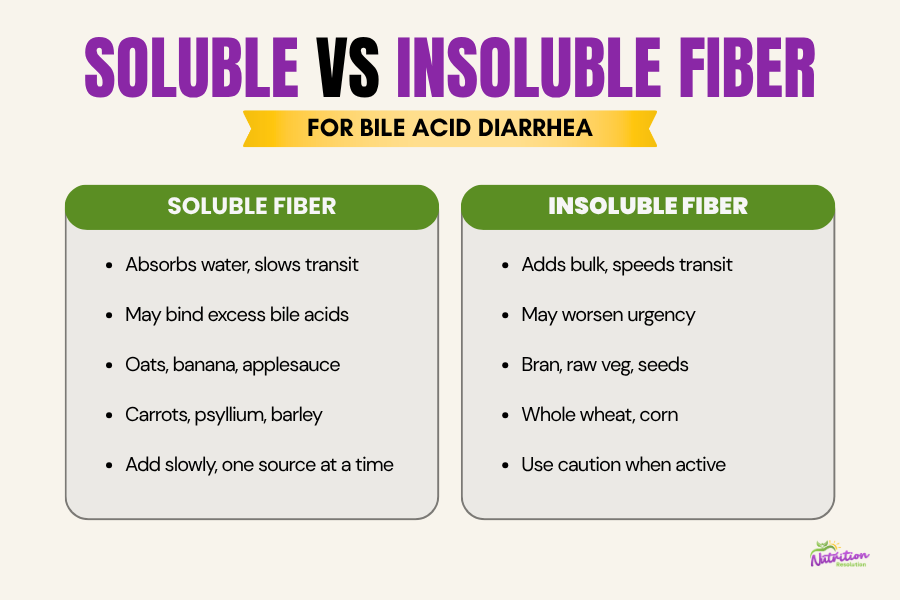
Soluble fiber can help with bile acid diarrhea by absorbing water and forming a gel-like substance in the digestive tract. This may help bind some of the excess bile acids reaching the colon, slow the movement of stool, and make bowel movements more formed and easier to control.
This is different from simply telling someone with diarrhea to “eat more fiber.” Some types of insoluble fiber add bulk and can speed food through the digestive tract, which may make urgency or diarrhea worse when symptoms are active. Soluble fiber tends to be gentler because it holds onto water rather than simply pushing more material through.
Useful sources of soluble fiber include:
- Oats and oat bran
- Barley
- Beans and lentils
- Apples and Pears
- Bananas
- Citrus fruits
- Carrots
- Sweet potatoes
- Psyllium husk
The form of the food matters here, too. A bowl of oatmeal, applesauce, or well-cooked carrots may be much easier to tolerate than a large amount of raw produce or bran cereal. And if beans or lentils leave you bloated, that does not mean soluble fiber itself is a problem. It may simply mean we need to use a different source or start with a much smaller portion.
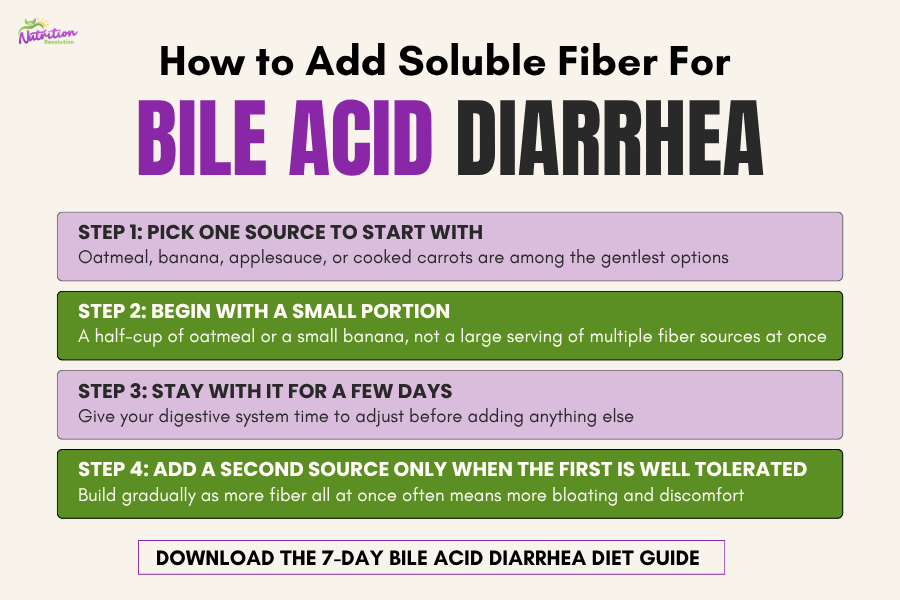
The biggest mistake is adding too much too quickly. Someone reads that fiber can help, starts eating large servings of oats, beans, chia seeds, fruit, and vegetables all at once, and then wonders why they feel bloated and uncomfortable. More is not automatically better. I usually recommend adding one source at a time, beginning with a modest portion, and increasing gradually as your digestive system adjusts.
Psyllium can also be a useful option because it provides a concentrated source of soluble fiber and is one of the most commonly recommended natural bile acid binders. It should still be introduced slowly and taken with enough fluid. Your ideal amount will depend on your current diet, stool pattern, and how sensitive you are to changes in fiber.
Our Bile Acid Diarrhea Diet Guide includes practical sources of soluble fiber within a much more complete food list and shows you how to incorporate them into actual meals. We’re not trying to pile fiber on top of an already irritated digestive system. It is to use the right type, in the right amount, to help make your symptoms more manageable.
Should You Follow a Low FODMAP Diet for Bile Acid Diarrhea?
A low FODMAP diet is not automatically necessary for bile acid diarrhea. It may help if you also have IBS or difficulty tolerating certain fermentable carbohydrates, but it does not directly address the excess bile acids irritating the colon.
In fact, when someone tells me they have been following a strict low FODMAP diet and are still experiencing frequent, urgent diarrhea with very little improvement, that is a major clue. It makes me question whether FODMAPs are really the primary issue and consider whether bile acid diarrhea could be contributing. This is one of the patterns I pay very close attention to in practice.
If bile acid diarrhea is contributing, we are talking about a completely different dietary approach. That person may be severely over-restricting their diet by avoiding FODMAPs when what they actually need to pay attention to is the amount and distribution of fat. A strict low FODMAP diet, especially during its most restrictive phase, is also considerably more difficult to follow than a moderate-fat diet.
Of course, the two issues can overlap. Someone may have bile acid diarrhea and also notice that certain FODMAPs contribute to bloating, gas, abdominal pain, or looser stools. But that does not necessarily mean they need to follow the entire low FODMAP diet at its most restrictive level.
I talk with people all the time who feel as though they need one diet for one digestive issue and another diet for something else. Before long, they are trying to follow several diets simultaneously and feel like there is almost nothing left to eat. This is where working with a dietitian can make such a difference.
In our practice, we help clients determine which dietary changes are actually improving their symptoms and find their individual tolerance thresholds. That may mean adjusting the amount and distribution of fat while making targeted changes to only the specific FODMAPs that cause problems. What we don’t want is to layer multiple restrictive diets on top of one another and follow every rule indefinitely. Instead, our goal is to create the least restrictive, most personalized approach that genuinely helps you feel better.
How Can a Dietitian Support Your Bile Acid Diarrhea Treatment?
Bile acid malabsorption treatment, also called bile acid diarrhea treatment, often includes dietary changes along with medication and, when appropriate, addressing what’s causing it. A dietitian who understands bile acid diarrhea can help you manage symptoms without simply handing you a low-fat food list. In our practice, we look at how much fat you are eating at one time, how it is distributed throughout the day, your soluble-fiber intake, whether you are meeting your nutritional needs, and which foods you may be avoiding unnecessarily.
Many people who come to us are also interested in natural treatment for bile acid diarrhea. We can absolutely help you use evidence-based dietary and lifestyle strategies, but I don’t think of these as an alternative to medical care. Instead, they’re one important part of a comprehensive treatment plan that may also include medication, depending on what is driving your symptoms.
This is where deeper clinical experience matters. We pay attention to patterns such as whether symptoms are worse after a large restaurant meal, whether spreading fat more evenly changes your urgency, or whether diarrhea continues despite a strict low FODMAP diet. We also look for overlapping digestive issues that may be affecting what you tolerate. Sometimes the most useful adjustment is not eliminating another food. It is understanding why the same food causes symptoms in one context but not another.
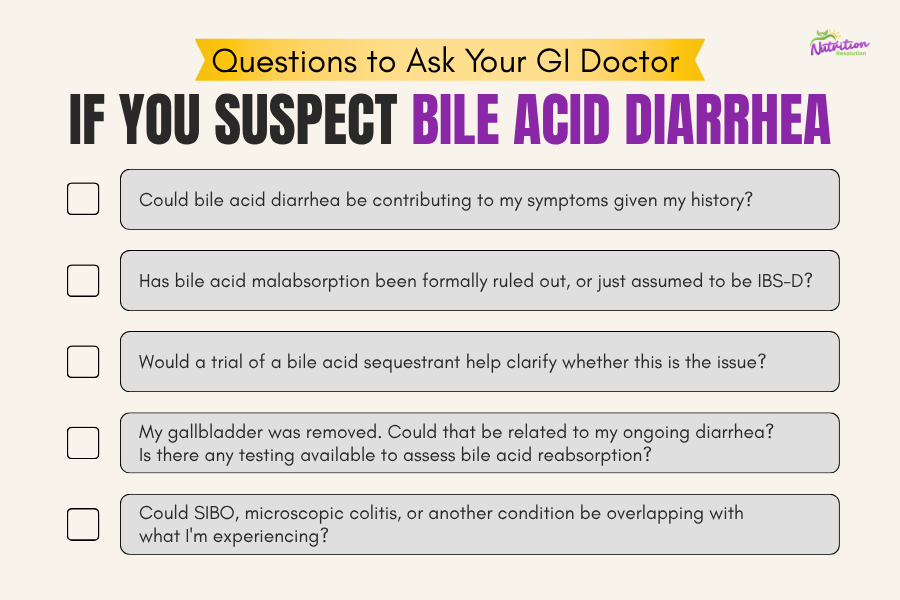
Bile acid diarrhea also does not always occur in isolation. Someone may also be dealing with IBS, small intestinal bacterial overgrowth (SIBO), food intolerances, altered gut motility, dysbiosis, or difficulty digesting and absorbing other nutrients. Previous gallbladder removal, intestinal surgery, or another underlying digestive condition may also be relevant. We look at what else may be contributing because improving one part of the picture may not resolve every symptom.
That is where our functional approach at Nutrition Resolution comes in. We help clients calm the most disruptive symptoms while looking at how bile acid diarrhea fits into the broader digestive picture. We consider meal patterns, nutritional adequacy, overlapping symptoms, unnecessary food restrictions, microbial influences, inflammation, nutrient absorption, and digestive function.
We also order functional testing that clients often have difficulty accessing through a standard medical practitioner. Depending on what is going on, that might include breath testing for bacterial overgrowth, stool microbiome analysis, or organic acids testing. These functional tests can give us useful information about digestive health and function, even though they are not designed to diagnose an overt disease and therefore are not typically part of standard medical care. If someone also needs further medical evaluation, conventional testing, or prescription medication, we work with their medical team on that part of the picture.
Then we put all of those findings together. Maybe bile acid diarrhea is part of what is happening, but there is also SIBO, altered gut bacteria, poor nutrient absorption, or another problem with digestive function. We help you understand how those pieces may be affecting one another and what to do about them.
That is where personalization really comes in. We are not following several different protocols by the book, or giving everyone with bile acid diarrhea the same plan. We are looking at your particular fingerprint and figuring out which dietary changes, functional strategies, and practical tools make the most sense for everything you have going on.
We’re not trying to make you follow a perfect bile acid diarrhea diet forever. We want you to understand your individual patterns, have practical tools you can use in daily life, and make informed choices without becoming a prisoner to an increasingly restrictive diet.
What Is the Best Way to Get Started?
The best place to start is by paying attention to the amount of fat you are eating at one time, spreading it more evenly throughout the day, and gradually adding soluble fiber. Our Bile Acid Diarrhea Diet Guide brings all of that guidance together in one practical resource, including a much more complete food list, a seven-day meal plan, and a grocery list.
As you use the guide, pay attention to your own patterns rather than expecting yourself to follow it perfectly. Notice which meals tend to trigger symptoms, how portions affect your tolerance, and which changes make the biggest difference. You are learning how to manage your diet, not become a prisoner to it.
If you are still struggling despite making these changes, or you suspect bile acid diarrhea is only one part of a more complicated digestive picture, you can apply to work with our team at Nutrition Resolution. We can help you look at everything that may be contributing and create a personalized plan for your particular digestive fingerprint.