When most people first hear what the elemental diet for SIBO involves, one detail gets all the attention: no regular food for two weeks. No dinners, no snacks, no sitting down to your usual family dinner. Just a nutritionally complete liquid formula. It sounds intense because it is.
And for years, that was exactly what made me shy away from recommending it. It was not because I doubted that it worked. It’s because replacing food with a liquid formula for two weeks felt like an enormous ask, and I did not want to put someone through something that difficult unless it was absolutely necessary.
Eventually, though, I realized I was making that decision for my clients before giving them the opportunity to make it for themselves.
We see this in health care all the time. A provider assumes someone will not consider an option because it is expensive, inconvenient, or not covered by insurance, so they never fully explain it. I have seen doctors do this with out-of-pocket services like working with a dietitian because they assume the patient will not want to pay for it. But should the doctor be making that decision for the patient? Absolutely not. Providers should explain the available options, recommend what they believe is in the person’s best interest, and let that person decide what they are willing and able to do. This is actually one of my biggest pet peeves, and yet I realized I was doing my own version of the same thing. I was shying away from the elemental diet because I assumed most people would feel that two weeks without food was simply too much.
But then, the more I thought about it, the more my perspective started to change. I kept hearing from colleagues whose clients had gone through the elemental diet and had remarkable results. Then some of our own clients started doing it, and I saw how powerful, and sometimes genuinely life-changing, those two weeks could be.
That is when I realized something important. Two weeks without food looks very different to the average person than it does to someone who has spent years dealing with severe bloating, constipation, diarrhea, pain, increasingly limited food choices, and one disappointing protocol after another. For someone in that position, two focused weeks that could genuinely change their life may feel far more manageable than another six months of trying things that may or may not work. Many of the people who come to us are not looking for the easiest possible option. They want to know which option gives them a real opportunity to finally move forward.
And the research gave me more reason to reconsider. Two clinical studies conducted more than 20 years apart found substantial improvements in breath-test results after just two weeks. The newer study also showed that a more palatable formula could help people complete the full protocol.
Those results changed the conversation for me. We now present and use the elemental diet much more often in our practice, especially when gas levels are extremely elevated, previous approaches have failed, or the broader microbiome has already taken too many hits.
But there is an important piece missing from most conversations about the elemental diet. Clearing the overgrowth is not the entire recovery process. In our five-phase approach, the elemental diet belongs primarily in Phase 3, when we rebalance the microbiome. What happens before those two weeks affects how manageable the experience is and how well prepared you are to handle challenges if they come up. What happens afterward determines whether you can rebuild your gut, expand your diet, and protect the progress you made.
That is why this article walks you through the entire process: what needs to happen before you begin, what to expect during the elemental diet, and how to retest, rebuild, and return to food afterward.
Considering an Elemental Diet?
Knowing what to do before, during, and afterward can make the process feel much more manageable. Our free Elemental Diet for SIBO Planner brings those steps together in one practical resource, including:
Use it with your provider to prepare with more confidence, track what changes, and have a clear plan for what happens after the last day of formula.
What Is the Elemental Diet, and How Does It Work for SIBO?
The elemental diet is basically food broken down into its smallest building blocks. In a sense, it is predigested, although it is not quite as gross as that sounds.
When we eat regular food, our digestive system has to break carbohydrates, fats, and proteins down into smaller components before we can absorb and use them. Elemental nutrition skips much of that work by providing nutrients in forms that are already ready, or nearly ready, for absorption.
It still provides complete nutrition, including carbohydrates and fat for energy, amino acids supplying the building blocks of protein, and essential vitamins and minerals. This is not fasting, a cleanse, or an ordinary protein shake. A liquid diet for SIBO needs more than a liquid texture; the formula’s nutrient composition is what makes it elemental.
It is also different from standard nutrition drinks and many tube-feeding formulas, even when those products are nutritionally complete. Those formulas typically contain intact proteins and other nutrients that still require more digestion. A fully elemental formula provides nutrients in pre-digested form, with free amino acids in place of intact protein, so they’re absorbed with very little digestive work.
What this means for small intestinal bacterial overgrowth, or SIBO, is that the formula nourishes you without continuing to provide nearly as much food for the overgrowth. With regular food, the carbohydrates, fats, and proteins you eat to feed your own body travel through the same area where those bacteria are living. The organisms ferment what is available to them, producing gases like hydrogen and methane. This fermentation can contribute to the bloating, pressure, visible distension, and pain that occur after eating when you have SIBO.
Because the nutrients in a fully elemental formula are already broken down, they are absorbed very early in the small intestine. This leaves very little behind to feed the organisms farther along the digestive tract. In simple terms, the elemental diet starves the overgrowth of its usual fuel. Researchers think that’s a big part of why breath tests improve so dramatically in elemental diet studies.
At Nutrition Resolution, we use the elemental diet as a highly structured, time-limited intervention to dramatically reduce the overgrowth while continuing to nourish the person. It is one powerful part of the larger plan, not the entire plan.
How Effective Is the Elemental Diet for SIBO and IMO?
The elemental diet has produced some of the strongest results we have seen for SIBO and intestinal methanogen overgrowth, or IMO. In two clinical studies conducted more than 20 years apart, approximately 73% to 80% of participants normalized their breath tests after just 14 days.
To put that in perspective, we often achieve excellent results with herbal protocols in our practice, but getting there may require multiple rounds over several months. What makes these numbers so remarkable is that they were achieved with one focused, two-week intervention.
What Did the Earlier SIBO Study Find?
In the original elemental diet study, published in 2004, researchers evaluated 93 people with IBS and abnormal lactulose breath tests. After two weeks on an exclusive elemental diet, approximately 80% had normalized their breath tests.
Participants who still had an abnormal breath test could continue for a third week. Including those who continued for a third week, approximately 85% of the 93 participants available for analysis had normalized their breath tests. Those whose breath tests normalized also experienced significant symptom improvement.
That study really put the elemental diet on the map as a serious intervention for SIBO. But the evidence was still limited to that one study, and the formulas available at the time tasted absolutely atrocious. So, for years, practitioners, including me, continued to think of the elemental diet as a last resort for people who had already exhausted every other option.
What Did the Newer Study Find?
The 2025 prospective clinical trial gave us important new evidence. Thirty adult patients with SIBO, IMO, or both consumed an exclusive, more palatable elemental formula for two weeks.
After those two weeks:
- 73% normalized their breath tests.
- Hydrogen and methane levels both decreased significantly.
- 83% reported adequate overall symptom relief.
- No serious or severe adverse events occurred.
- Every participant completed the protocol.
That last point matters. One of the most common arguments against the elemental diet is that people will not be able to tolerate or complete it. Yet all 30 participants finished the full two weeks. A formula designed to be more palatable does not make an elemental diet effortless, but this study showed that it can be realistic and achievable with the right formula and support.
Does the Elemental Diet Work for Methane SIBO or IMO?
The newer study also gave us something the earlier research could not: evidence specifically involving methane.
What is commonly called “methane SIBO” is more accurately called intestinal methanogen overgrowth (IMO) because methanogens are archaea, not bacteria. Among participants with IMO, including those who also had SIBO, approximately 67% normalized their breath tests. In the smaller group with IMO alone, approximately 58% normalized.
Breath tests did not normalize in everyone, but methane levels still fell substantially across the full study group. Average maximum methane levels dropped from 41 parts per million to 12.
That is extremely clinically meaningful. For someone struggling with persistent methane and constipation, a dramatic reduction can still represent major progress, even when one round does not bring the breath test fully into the normal range. You can learn more about methane and the larger plan for addressing it in our methane SIBO and IMO guide.
What Did the Newer Study Show About the Microbiome?
The newer study found that the elemental diet changed the microbiome without a persistent reduction in overall diversity at the two-week follow-up after food was reintroduced. Microbial diversity decreased during the two weeks on the formula, which is not surprising when participants were consuming no regular food. But after participants resumed their normal diet, overall diversity and broader microbial community composition were no longer significantly different from where they started.
At the same time, several potentially unfavorable organisms remained lower. Fusobacterium, a genus associated with hydrogen sulfide production and gut inflammation, declined. The study also found a sustained reduction in a group of Prevotella bacteria that includes a species associated with greater abdominal pain in IBS. Methanobrevibacter smithii, the predominant methane-producing organism in the human gut, also decreased, and its abundance tracked with methane levels.
This is extremely encouraging. The broader microbial ecosystem moved back toward baseline once food was reintroduced, while several of the organisms we wanted to reduce remained lower. For someone concerned about the broader microbiome effects of repeated antibiotic courses, that makes the elemental diet an especially compelling option.
How Does the Elemental Diet Compare With Antibiotics and Herbal Antimicrobials?
When choosing between the elemental diet, antibiotics, and herbal antimicrobials, I consider the time involved, previous responses, tolerability, and the condition of the person’s broader microbiome.
We achieve excellent results with herbal protocols in our practice, and they remain one of my preferred approaches. The difference is that herbal protocols often require multiple rounds over several months. With antibiotics, one round is often not enough to clear the overgrowth. Depending on the antibiotic and how many rounds are needed, I become increasingly concerned about disrupting beneficial bacteria while we are working to bring those gas levels down. That is one of the main reasons antibiotics are not usually at the top of my list.
So for me, herbal antimicrobials and the elemental diet are at the top of the list because, in my clinical experience, both tend to be gentler on the microbiome. The elemental diet is no longer something I save until every other option has failed. It deserves to be considered alongside the other approaches from the beginning, based on the person’s history, preferences, and clinical picture.
Who Should Consider an Elemental Diet for SIBO?
The elemental diet may be a strong option for someone with established SIBO or IMO who wants to avoid antibiotics, has not responded adequately to previous approaches, or prefers a short, intensive intervention over another extended protocol.
I am especially likely to present it when hydrogen or methane levels are substantially elevated. In our practice, we have seen gas levels of 70, 80, or even more than 100 parts per million drop dramatically after one two-week course. When someone is starting with numbers that high, the ability to make that much progress in such a short period is difficult to beat.
It may also make sense when antibiotics were ineffective or poorly tolerated, herbal antimicrobials caused significant side effects, or someone has already completed multiple rounds without getting where they need to go. Some people simply do not want to take antibiotics or another long list of supplements. For them, two intensive weeks on an elemental liquid diet may feel far more manageable than committing to another protocol lasting several months.
I also consider the condition of the person’s broader microbiome. Some people have spent years following a very limited low-FODMAP diet or eating only a handful of foods. Others have completed round after round of antibiotics. When I am already concerned that certain beneficial bacteria may already be reduced, I am much more cautious about recommending anything else that could take out additional beneficial bacteria. In those cases, the elemental diet becomes especially appealing.
One of the clients I have worked with, Scott, had already completed two courses of antibiotics. Each time, his bowel movements improved temporarily, but the symptoms returned. By the time he came back to work with me, he was experiencing diarrhea no matter what he ate, and foods he had previously tolerated were causing pain. His diet was becoming increasingly restricted, and he was exhausted from trying to manage it all.
We decided to use the elemental diet. It was not easy, but after completing it and following the larger plan we built around it, Scott told me he felt better gastrointestinally than he had in several years. He was able to start eating out with friends again and bring foods he loved back into his diet.
Quality of life matters here, too. If someone is severely bloated every day, afraid to eat, or watching their diet become increasingly restricted, we may not want to spend several more months slowly working through one round after another. The elemental diet gives us an opportunity to make substantial progress and then move into the equally important work of repairing, rebuilding, and expanding the diet.
However, strong results depend on choosing the right person and supporting them properly. At Nutrition Resolution, we look at the person’s full health and symptom history, previous approaches and responses, breath-test pattern, constipation and motility, weight and nutritional status, medical conditions, medications, and practical readiness. We also talk honestly about what the person wants and what they are willing and able to do. An elemental diet requires planning, enough formula to meet nutritional needs, monitoring throughout the process, reassessment afterward, and a structured transition back to food.
Weight and nutritional status deserve a little more explanation because this is one area where the elemental diet is often misunderstood. Being underweight or at risk of malnutrition does not automatically rule someone out. In fact, the elemental diet may be especially useful when pain, bloating, diarrhea, or malabsorption has made it difficult to eat or absorb enough nutrition. Because the formula is nutritionally complete and requires very little digestion, we can calculate an appropriate calorie target and provide those nutrients in a form that is easier to absorb. We often find that even underweight clients can maintain their weight because they are finally able to consume what they need without provoking the same symptoms they experience with food.
That does not mean we stop paying attention to weight. In the newer trial, participants lost some weight even though their formula was calculated to meet their calorie needs, including a reduction in body fat. So, if someone is already losing weight rapidly or is severely malnourished, we want their medical team involved, and we monitor them much more closely.
We also need to be especially careful with pregnancy or breastfeeding, an active or recent eating-disorder history, diabetes or unstable blood sugar, kidney disease, ingredient allergies, or any other medical condition that could affect which formula is appropriate or how someone responds to it. These concerns do not all automatically rule out the elemental diet, but they do change how we make the decision and what kind of monitoring is needed.
Wondering Whether the Elemental Diet Makes Sense for You?
If you are interested in the elemental diet, you do not have to wait until you are inside our program to ask your questions. Bring them to a free strategy call, where we can talk through your situation and give you more clarity about whether the elemental diet is an option worth exploring.
Which Elemental Diet Formula Should You Use?
The best elemental diet powder is nutritionally complete, appropriate for your individual needs, tolerable enough to consume in the required amount, and supported by evidence relevant to how you plan to use it.
The first distinction is between a fully elemental and a semi-elemental formula. A fully elemental formula provides protein as individual amino acids, requiring almost no digestion. A true semi-elemental formula provides protein as smaller peptides. Formulas containing intact proteins, such as whey protein isolate, still require more digestion.
When choosing the best elemental diet for SIBO, I favor a nutritionally complete, fully elemental formula because that is what was used in the main clinical studies. We do not recommend a semi elemental diet for SIBO as an equivalent substitute because we cannot assume it will produce the same breath-test results.
SIBO is not the only situation where this distinction matters. When an elemental diet is used for eosinophilic esophagitis, we would also choose a fully elemental, amino-acid-based formula to avoid the food proteins that can trigger inflammation.
For other uses, however, a fully elemental formula is not necessarily needed. Formula-based nutrition is used for Crohn’s disease, including in children, and other formulas can be effective and easier to drink. The right choice depends on the condition and the goal.
If you are considering an elemental diet for IBS because your symptoms make eating enough difficult, this may be a situation where a semi-elemental formula makes more sense. Its more palatable flavor may make it easier to fill nutritional gaps or replace a poorly tolerated meal. Here, the goal is to help you get enough nourishment by using the formula alongside regular food, either to supplement what you can eat or replace a meal that is particularly difficult to tolerate.
Some of the commercial options currently available include:
- mBIOTA is a fully elemental, nutritionally complete oral formula used in the newer clinical trial involving people with SIBO and IMO. It was specifically designed to address the palatability problems that made older formulas so difficult to complete.
- Vivonex Plus is the fully elemental medical formula used in the original 2004 SIBO study. It produced impressive results, but the taste was notoriously difficult.
- Physicians’ Elemental Diet and its dextrose-free version are fully elemental formulas designed for oral use. The original formula is the one Scott used, and I have to give him a lot of credit for getting through it because the taste is rough.
- Tolerex is an amino-acid-based medical nutrition formula developed primarily for people with severely impaired digestive function, rather than specifically as a palatable oral SIBO formula.
- Elemental Heal and Absorb Plus are commonly discussed as elemental-diet options, but their standard whey-based formulas contain intact protein, so they are not fully elemental.
I am making these distinctions because the word “elemental” is used pretty loosely in the marketplace. That does not mean a semi-elemental formula is inferior. Free amino acids taste rough, so using whey protein or smaller protein peptides can make a formula significantly easier to drink. That tradeoff helps explain the appeal of a Dr Ruscio elemental diet product such as Elemental Heal: a formula that tastes better may be easier to drink consistently and in the amount needed to meet nutritional needs.
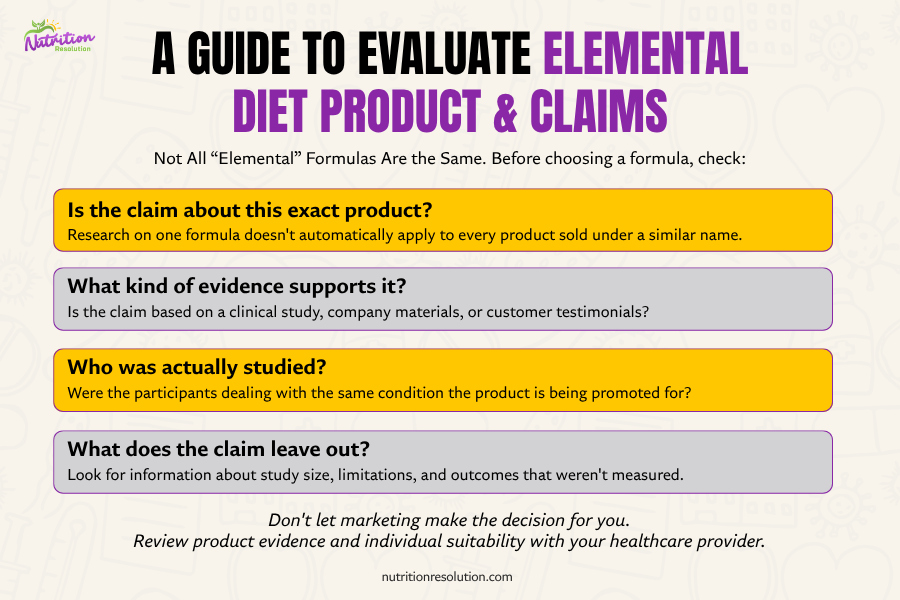
A more palatable formula may be worth considering for someone who would otherwise be unable to complete the protocol. For SIBO and IMO, however, I still prefer a fully elemental formula because that is what was used in both of the main clinical studies. We cannot assume that a formula containing intact protein or peptides will produce the same breath-test results.
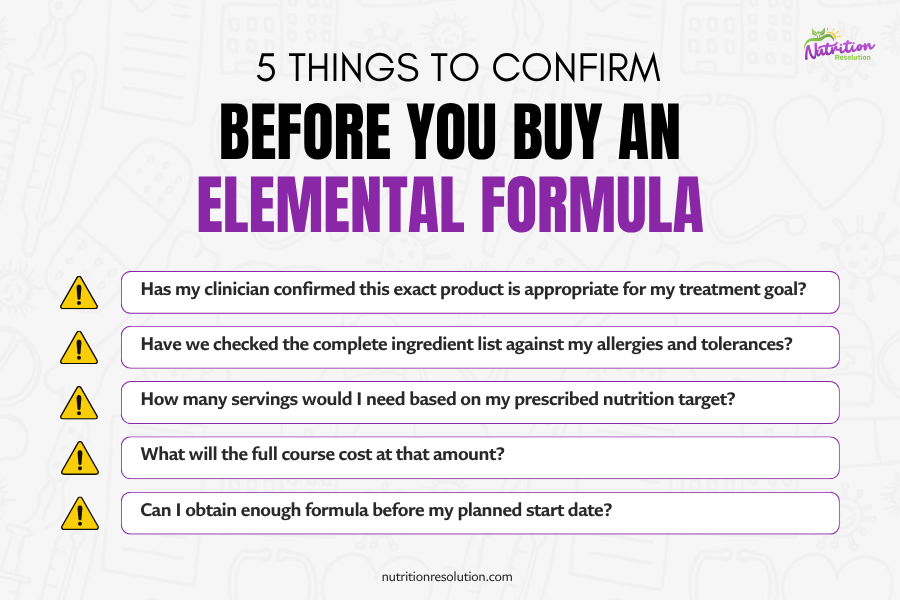
Formula selection still has to be realistic for the person drinking it. We consider the protein or amino-acid source, carbohydrate and fat composition, allergies and ingredient tolerances, calories per serving, cost, availability, and how much someone would need to consume each day. Taste matters because even a theoretically perfect formula will not work if someone cannot drink enough of it to meet their nutritional needs and complete the protocol.
Dr. Allison Siebecker also has a well-known homemade elemental formula recipe, which I have used with clients before. It provides a much better framework than trying to invent a formula yourself, but homemade formulas are still difficult to make palatable and require careful calculation. The amino-acid balance, essential fats, vitamins and minerals, total calories, concentration, and individual tolerances all matter when the formula will be someone’s sole source of nutrition.
At Nutrition Resolution, we have switched to using mBIOTA because it is nutritionally complete, tends to be much more palatable than older formulas, and was studied in the newer clinical trial involving people with SIBO and IMO. That does not make it the only appropriate formula. The right choice still depends on the individual and how the formula will be used.
What Should Happen Before and During the Elemental Diet?
What Should Be Planned Before Day 1?
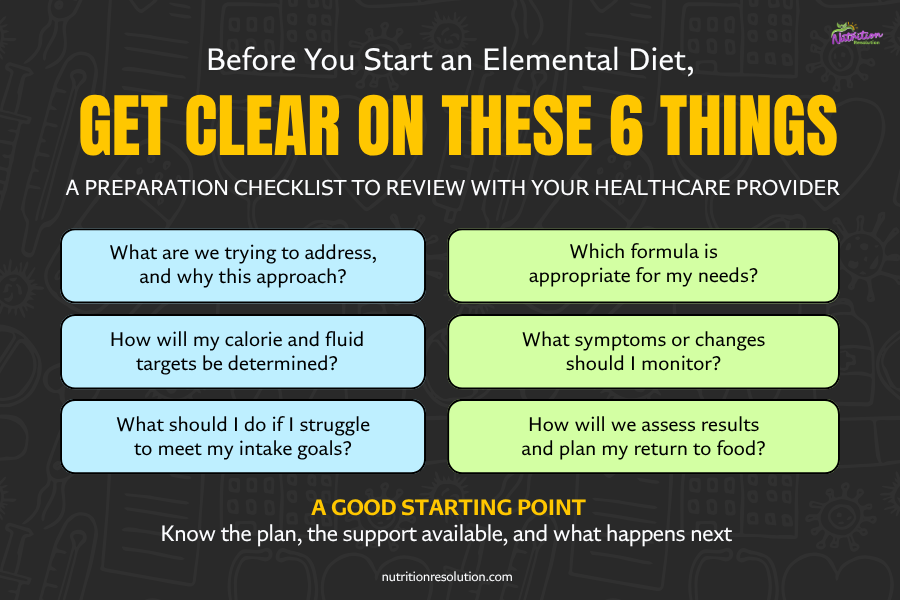
Before Day 1, you should have a clear, individualized plan for the formula, your nutritional needs, the length of the protocol, what you will monitor, how you will reassess, and how you will transition back to food. Having those decisions made ahead of time allows you to focus your energy on completing the diet rather than trying to figure everything out as you go.
At Nutrition Resolution, we start by getting clear on what we are addressing. We review your symptoms, breath-test pattern, weight and nutritional status, health history, medications and supplements, constipation, and motility. From there, we choose the formula, calculate a calorie target, estimate fluid needs, and make sure you have enough formula and supplies before you begin.
Most SIBO and IMO protocols start with 14 days. In our practice, we retest the following morning, on Day 15, usually with FoodMarble. The client can do the breath test at home, and we can see their hydrogen and methane results right away. If hydrogen and/or methane gas levels are still elevated, we can move directly into a third week. We are not guessing, and we are not stopping the diet while we wait for answers.
That immediate result is a huge advantage. With a traditional mail-in breath test, we might wait two weeks for the results. By then, it is too late to simply continue into a third week. FoodMarble lets us make that decision while the person is still in the process.
The elemental diet also does not happen in isolation. In our five-phase process, we begin by calming and priming the system. The first few days can be uncomfortable, so we do not want someone starting when they are already at their absolute worst. In Phase 1, we work on calming symptoms and lowering that baseline burden so the body has some breathing room. We may focus on hydration, adequate nutrition, bowel regularity, and other individualized support before the elemental diet begins.
In Phase 2, we identify the root causes and other contributors that matter most. Then we use the elemental diet in Phase 3 to rebalance the microbiome. That does not mean every root cause has to be completely resolved before someone begins the elemental diet. We just want to understand the bigger picture, prepare the body for what is coming, and have a plan for the repair and rebuilding work that follows.
Then there is the real-life side of it. Following a SIBO liquid diet for two weeks affects your workday, family meals, social plans, grocery routines, and many of the ways you normally find comfort and connection. We talk through those situations before you begin, come up with a plan that fits your life, and then stay closely connected throughout the two weeks. Our clients have messaging support as questions come up, so we can troubleshoot symptoms, make adjustments, and help them keep moving forward without feeling like they have to figure everything out alone.
The formula is only one part of the preparation. Use The Elemental Diet Before-and-After Planner to organize your intake plan, symptom tracking, questions for your practitioner, retesting, food transition, and follow-up.
What Can You Expect During the Two Weeks?
During the two weeks, most people drink their elemental diet shakes every few hours, sip each serving slowly, and continue drinking water throughout the day. Everyone responds differently, but it can help to have a general picture of how the two weeks may unfold:
- Days 1–4: This is usually the adjustment period. You are getting used to liquid nutrition, finding a preparation method you like, and establishing a routine that helps you meet your calorie and fluid needs.
- Days 5–7: Some people begin finding their rhythm and tolerating the formula more comfortably. Others still need adjustments to how much they drink, how they prepare it, or how they space it throughout the day.
- Around Day 8: Many people start feeling better, and the process begins to feel easier. In our experience, this is often when some of the early discomfort starts settling down.
- Days 9–14: Keep working toward your daily intake goals and confirm the plan for retesting and returning to food with your practitioner.
The daily tracker in our free Elemental Diet for SIBO Planner gives you a simple place to record your formula and fluid intake, symptoms, bowel movements, and energy. This can help you and your provider recognize patterns and see where your plan may need adjusting.
These are general expectations, not a schedule your body has to follow. Some people feel better early on, while others feel unwell throughout the entire two weeks and still have good results. So I encourage you not to judge how well it’s working based on how you feel from day to day. Symptoms alone don’t tell us how much the overgrowth has changed, which is why we retest.
That doesn’t mean we ignore how you’re feeling. If you are experiencing elemental diet side effects, we look at intake, hydration, formula tolerance, and other possible contributors rather than automatically assuming everything is die-off. The goal is not to feel as bad as possible, and more intense symptoms do not mean better results.
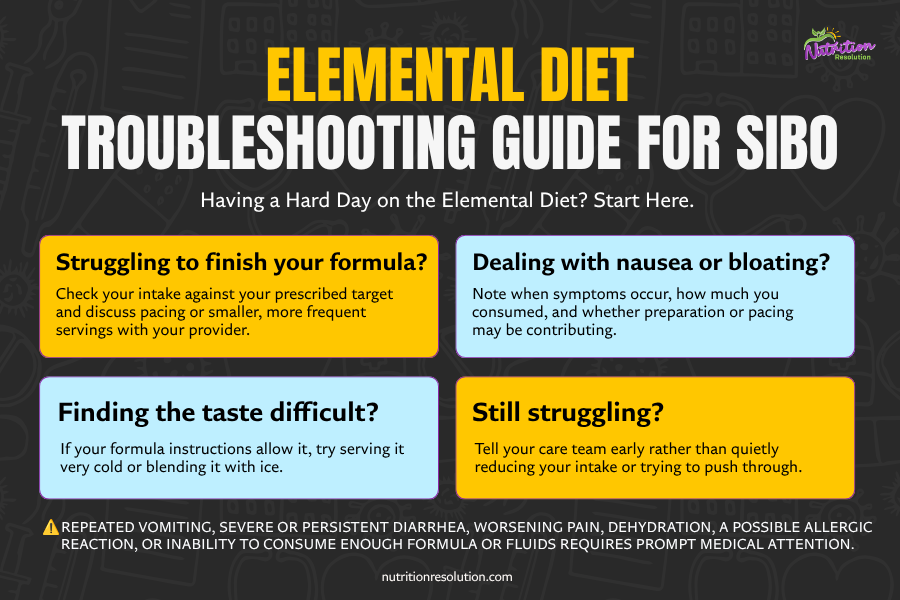
To help make those two weeks more manageable, we calculate how much formula you need each day and help you decide how to space it out. How you drink it matters, too. We generally recommend taking at least 30 minutes to sip each elemental diet shake rather than drinking it all at once. If you’re feeling nauseated or bloated, slowing down further or drinking smaller amounts more frequently may help. Just make sure those smaller amounts still add up to your daily intake goal.
Getting enough formula and water also matters. If you are falling short on calories or fluids, you are much more likely to feel hungry, exhausted, headachy, or simply awful. Those symptoms do not necessarily mean something is going wrong with the protocol. Sometimes they mean we need to adjust your intake. If you usually drink coffee or tea and stop suddenly when you begin, caffeine withdrawal can also contribute to headaches. Talk through your usual caffeine intake with your practitioner before starting so you have a plan rather than another uncomfortable adjustment piled onto the first few days.
If nausea continues even after adjusting your intake and slowing down, let your practitioner know. Reflux can sometimes contribute to nausea, even without obvious heartburn, and some people have difficulty tolerating a particular formula. We look at what might be driving the symptoms so we can choose the right support rather than assuming you just have to wait it out.
Interestingly, many people tell us that physical hunger is not the hardest part. They miss eating. Food gives structure to the day. It is part of relaxing in the evening, sitting down with family, meeting a friend, and enjoying something familiar. So, if you miss food, that does not mean you are doing badly or are not committed enough.
There are a few things that can make this part feel much more manageable. The formula often tastes better very cold, so after mixing your elemental diet powder as directed, try serving it over ice or blending it into a slushy texture. Adjusting the amount of water within the recommended range can also make the flavor less intense.
It helps to decide ahead of time what you will do during the times you would normally eat. Some people still sit with their family and drink their formula, while others find that being around food makes the process harder. You might take a walk, watch an episode of something you enjoy, call a friend, work on a project, or use that time for another relaxing activity. The point is not to keep yourself constantly distracted. It’s just easier when mealtimes arrive and you already have a plan.
And while you are finding that new rhythm, your body is adjusting, too. Your bowel movements will probably change. Many people go less often because there is simply much less waste being produced, but stools can also become looser, especially during the second week. So you may be going less often and still having loose stools. Bowel patterns can take time to settle as food comes back in. Some people also experience headaches, fatigue, brain fog, body aches, chills, nausea, diarrhea, bloating, cramping, or a temporary increase in familiar digestive symptoms. For some people, it is fairly mild. For others, it can be one of the hardest parts of the elemental diet.
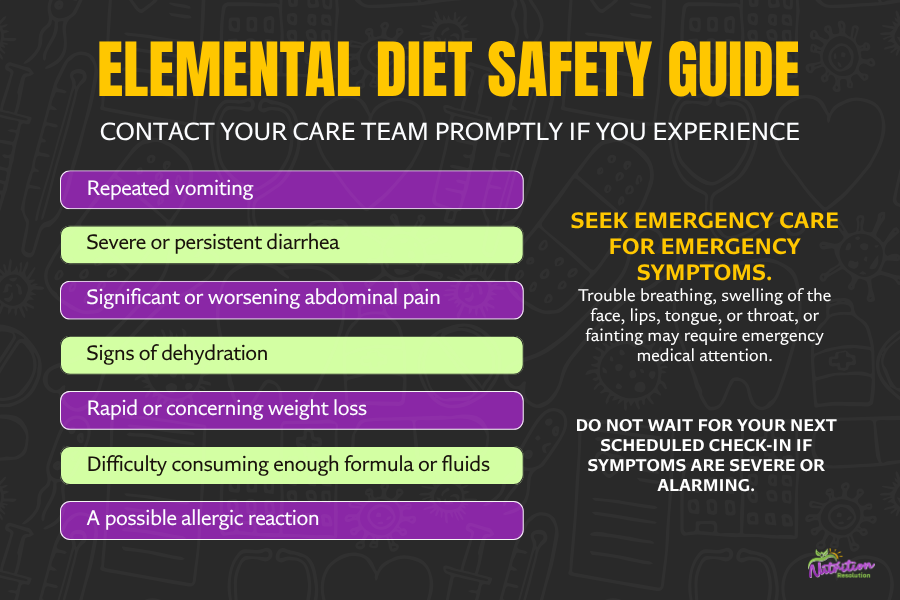
There is a difference between a difficult adjustment and symptoms that need medical attention. Repeated vomiting, severe or persistent diarrhea, worsening pain, signs of dehydration, an allergic reaction, or being unable to consume enough formula or fluid should not simply be pushed through. Contact your care team promptly so they can assess what is happening and whether you need medical evaluation or changes to the plan.
I think of one client we worked with recently who started the elemental diet extremely motivated, but several days in, she developed nausea and taste fatigue. Drinking the same formula day after day was getting harder, and she gradually started taking in less than she needed. As her intake dropped, her energy did, too, and she began to wonder how she would make it through the full two weeks.
We helped her adjust how she prepared and paced the formula, encouraged smaller amounts more frequently, and worked with her on hydration and nausea support. We also stayed closely connected so we could monitor how she was doing and recognize when symptoms needed additional medical attention. She began feeling better, increased her intake, and was able to keep going.
This is why I recommend having support throughout the two weeks. A difficult day does not necessarily mean you cannot complete the diet. Sometimes the plan needs adjusting, and having someone who knows your case makes it easier to figure out what to change.
Want Support With the Elemental Diet?
If you are considering the elemental diet but do not want to figure it all out alone, schedule a free strategy call with our team. You can ask your questions and learn how we support clients through the entire process, from preparing for the elemental diet and getting through the two weeks to retesting, transitioning back to food, rebuilding the gut, and addressing the factors that allowed the overgrowth to develop in the first place.
How Do You Know Whether the Elemental Diet Worked?
We look at three things: what happened to the hydrogen and methane levels on your breath test, whether your symptoms improved, and how your body responds as you transition back to food.
Ideally, hydrogen and methane return to the normal range. But normalization is not the only result that matters. If someone starts with methane at 80 parts per million and comes down to 15, that is still an enormous amount of progress, even though the number is not technically normal yet. The same is true for a substantial drop in hydrogen. We want to understand how much the overgrowth changed, not reduce the entire outcome to a simple pass or fail.The retest we planned before starting helps us decide whether to transition back to food or continue into a third week.
Symptoms give us another piece of the picture, but their timing is not always straightforward. Some people feel better during the elemental diet. Others are dealing with enough die-off or discomfort that they do not recognize the improvement until they begin eating again. And even when the breath test normalizes, that does not mean every digestive symptom will disappear immediately. Some people notice more improvement over the next week or two as they transition back to food. How you feel on Day 14 is not necessarily how you’ll feel two weeks later. In fact, that is why our process includes Phase 4, Repair and Rebuild, and Phase 5, Reintroduce and Expand. Symptoms and food tolerance often continue to improve as we rebuild the gut, support digestion and motility, and carefully expand the diet.
As food returns, we keep watching. Is bloating improving? Are bowel movements becoming more regular? Is the person maintaining their weight and getting enough nutrition? Are energy and food tolerance moving in the right direction?
What Should Happen After the Elemental Diet?
After the elemental diet, we bring food back purposefully and then shift our attention toward rebuilding the gut, supporting motility, improving nutritional adequacy, and expanding the diet. This transition should already be planned before Day 1 because the last thing you want is to finish two or three weeks without food and suddenly realize you have no idea what to eat.
How Should You Transition Back to Solid Food?
For a practical starting point, our free Elemental Diet for SIBO Planner includes a seven-day framework for bringing food back, with guidance on portions, textures, variety, and what to do if symptoms appear.
Keep in mind that this framework is a starting point. There is no single transition diet that is right for everyone. Some protocols begin very cautiously with a day or two of simple foods with a low fiber content, followed by well-cooked or pureed vegetables and gradually more texture and variety. Others begin with simple, lower-fermentation meals and expand the diet more quickly over the first week.
After the mBIOTA elemental diet, the company’s transition guide moves people toward Low Fermentation Eating. We think parts of that approach can be very useful while the digestive system is adjusting to food again, but we do not necessarily use it as the long-term destination. The broader idea behind a low-fermentation diet is to limit the fermentable carbohydrates available to gut microbes. That may reduce symptoms, but it also limits many of the foods that feed the beneficial bacteria we ultimately want to rebuild.
Our philosophy is different. We do not want to starve the good bacteria indefinitely in an effort to keep the overgrowth from returning. The large intestine is supposed to contain a robust, diverse microbial community, and those organisms need fermentable plant foods for fuel. The goal once the overgrowth is cleared is to rebuild the microbiome strategically so the person can return to a more diverse, nourishing diet.
So how do we work to prevent the overgrowth from returning? We look at the specific root contributors for that person. That may mean supporting the small intestine’s clearing waves between meals, improving constipation or pelvic floor function, or addressing problems with stomach acid, bile flow, digestive enzymes, nervous system regulation, medications, post-infectious changes, or structural issues. We also work on rebuilding a depleted large-intestinal microbiome rather than keeping it starved indefinitely. The short version is that we do not rely on long-term food restriction to prevent recurrence. We work on restoring the systems that are supposed to regulate bacterial levels and keep everything moving in the first place. If you want to understand much more about what causes SIBO and how we work to keep it from coming back, read our guide to SIBO root causes and recurrence prevention.
And when it comes to bringing food back, the process looks different for everyone. Someone who was tolerating chicken, rice, potatoes, eggs, and several cooked vegetables before the elemental diet probably does not need to reintroduce every one of those foods as though they have never eaten them before. We may bring previously tolerated foods back fairly quickly while taking more time with foods that were causing symptoms.
Some people also continue using a small amount of elemental formula while food returns. This can make the transition feel less abrupt and help them meet their calorie and protein needs while portions are still smaller. Once you are comfortably eating solid food again, we can move beyond the transition diet and begin the deeper work off rebuilding the gut and expanding your food choices.
What Happens During the Repair and Rebuild Phase?
After that initial transition back to solid food, we move into Phase 4, Repair and Rebuild. This is where we start rebuilding what years of restrictive diets, repeated treatments, and digestive dysfunction may have depleted. We focus on restoring beneficial bacteria, strengthening the gut lining, and replenishing nutrient reserves. This helps the gut become less reactive, more stable, and better prepared for the wider range of foods we will begin bringing back in Phase 5.
Stool analysis gives us a much broader look at the large-intestinal microbiome. We look at the beneficial organisms detected, their relative abundance, and available clues about their activity, alongside symptoms, diet, and other findings, to help guide our rebuilding plan. Instead of automatically giving everyone the same probiotic and generic list of gut-healthy foods, we can create a much more strategic and personalized plan for getting that microbiome stronger and more diverse again.
How Do You Reintroduce and Expand the Diet?
Once that rebuilding work is underway, we move into Phase 5, Reintroduce and Expand. This is where the process gets really exciting. Many of the people we work with have been stuck eating the same handful of “safe” foods for months or even years. Now we can start moving beyond that limited diet and bringing back more fermentable plant foods.
For Scott, this meant finding out which foods he could comfortably bring back and building confidence with meals again. The elemental diet gave us a starting point; the work afterward helped him use that progress in everyday life.
And we do not have to guess our way through that expansion. FoodMarble is not just a way to test for bacterial or methanogen overgrowth. It also helps us track breath-gas patterns alongside food intake and symptoms as we reintroduce specific FODMAPs. Once we have cleared the overgrowth, we can go back and retest some of the assumptions you may have been living with for years. Some foods that caused symptoms before the elemental diet may be better tolerated afterward. After the overgrowth is gone, many of our clients find that they can tolerate FODMAPs perfectly well, including foods they had avoided for years. Others may still cause a response and need more time or support. FoodMarble helps us see the difference so we can expand your diet based on what your gut is doing now, not what it was doing when the SIBO was still there.
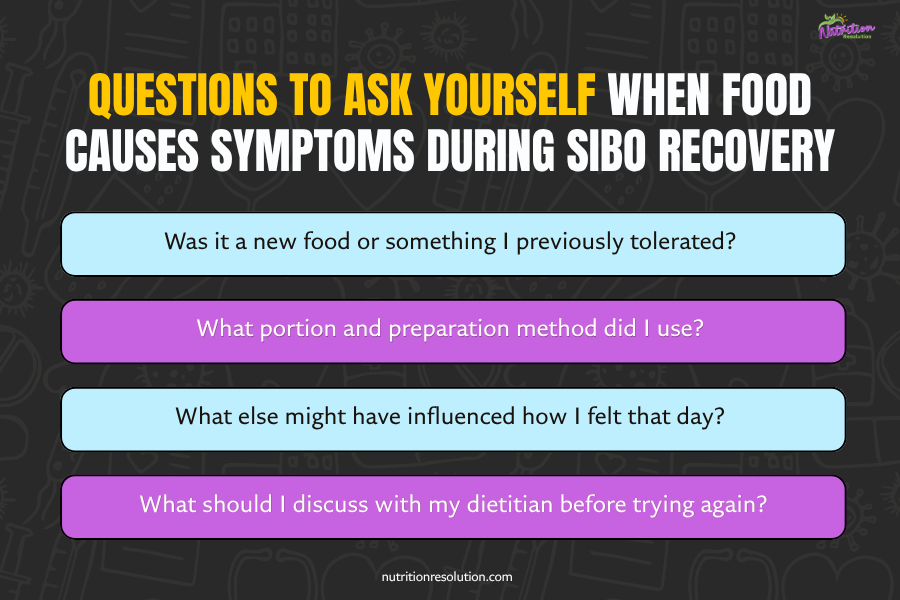
Also, a symptom after one meal does not automatically mean that food needs to disappear again. We look at the amount, how it was prepared, what else was happening that day, and whether the same response occurs consistently. The goal is to keep moving toward greater plant diversity, better nutrition, and much more confidence around food.
I think of another client whose breath-test gases completely normalized after the elemental diet, but she was still constipated and nervous about bringing food back. Every episode of bloating made her worry that the SIBO had already returned.
We had to look at the bigger picture. She had just spent two weeks without solid food, so she was producing very little waste and was not yet getting the fiber she normally needed to keep her bowels moving. Her repeat breath test no longer showed elevated methane, so we looked at other contributors to the constipation. As we rebuilt her gut and gradually brought fiber and other foods back in, her bowel movements improved. She also learned that a little bloating while her digestive system adjusted did not automatically mean the SIBO was back.
Over time, she began tolerating foods she had avoided for years, eating more of the same meals as her family, and feeling more comfortable going out to eat. Normalizing the breath test was exciting, but getting that freedom back was the real win.
This is why our work with clients does not end on Day 14. The elemental diet may create the opening we need, but we still have to help the digestive system function well and help the person rebuild a life around food.
Why Is Clearing SIBO Still Only One Part of the Process?
Finishing the elemental diet is a milestone, but what matters most is what it allows you to do next. Can you eat a broader range of foods, meet your nutritional needs, feel more comfortable, and spend less of your day managing digestive symptoms?
That is why we plan for both sides of those two weeks. The elemental diet can create a powerful turning point. Preparing beforehand and following through afterward helps turn that progress into a better everyday life.
Ready to Plan Your Next Steps?
Download our free Elemental Diet for SIBO Planner to put what you’ve learned into practice. With preparation checklists, daily trackers, questions for your provider, and a seven-day framework for returning to food, it helps you organize the entire process, including what happens after the formula ends.